
Everyone remembers those moments in childhood when, out of boredom, we began to study our surroundings in minute detail.
As adults, we stop looking at our surroundings with such scrutiny and lose that curiosity about the world around us. However, one autumn afternoon, an eight-year-old child named Hugo Dins discovered a phenomenon that turned the scientific community upside down. He was playing in a Pennsylvania forest near his home, looking for something to do, when he came across a collection of small, round objects near an ant nest.
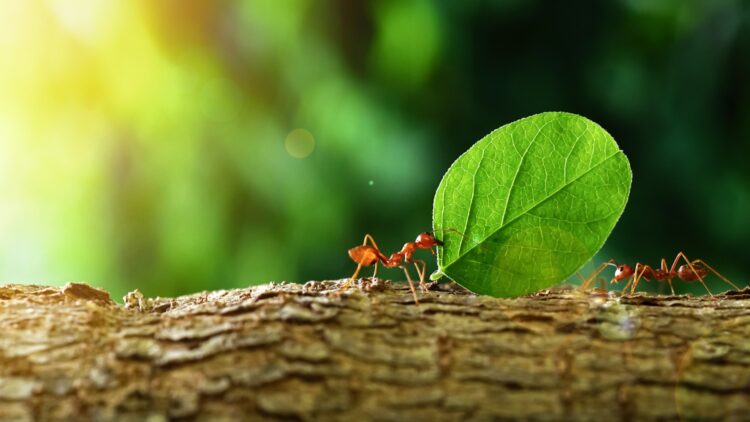
The ants were collecting these small objects and carrying them to their underground nest as if they were seeds for the winter. Very interested in his discovery, Hugo called his father, Andrew Deans, a professor of entomology at Penn State. While Hugo thought he would give him a logical explanation for what was happening, his father was stunned: the orbs were not seeds, but oak gallnuts, tumor-like plant structures that often harbor wasp larvae. But how had they gotten there?
What began as a simple childish question turned into a scientific study published in 2022 in the prestigious journal The American Naturalist. Hugo’s discovery uncovered a hidden parasitic relationship that had gone unnoticed by science for more than a century. There’s nothing like a child’s curiosity, right?
What is myrmecochory?
Nature is full of mutualistic interactions, meaning that both parties benefit. One such interaction is called myrmecochory (from the Greek myrmēx, ‘ant’, and khōrein, ‘to scatter’): that is, the dispersal of seeds by ants. Certain plants, called myrmecochores, produce seeds with a fatty, nutritious appendage that is highly appealing to ants, known as an elaiosome (“oil body”).
The worker ant collects the whole seed, carries it underground, and consumes the nutritious oil that serves as food for its larvae. The rest of the seed is discarded near the nest in a safe, nutrient-rich place (which is why you will always find a mound of straw and seed husks near an ant nest). This situation is a win-win for everyone: the ant gets food, the plant gets its offspring dispersed, and ends up planted in a place with ideal soil for germination.
The wasp’s trick unveiled by a child: the ‘Kapéllo’
The objects Hugo found are part of another phenomenon called parasitic mimicry. The process begins when a wasp lays an egg in the tissue of an oak leaf. To do this, the wasp injects a chemical that genetically manipulates the plant. The oak tree, confused, builds a protective and nutritious plant capsule around the developing larva. These are the gallnuts that Hugo found.
Yes, the wasp only manipulates the tree. However, something that entomologists did not realize is that the capsule also creates a small fleshy cap filled with the same fatty acids that ants seek in the elaiosome of seeds. The poor foraging ants are unable to tell the difference, so they take the gallnuts to their nest as if they were seeds.
Once there, they consume the kapéllo and discard the intact galbulus. The wasp larva thus obtains essential protection against predators such as mice and birds, and a stable microclimate for its development, all without giving anything in return. It is pure parasitic exploitation.
Other examples from nature
Interactions between insects and flora are often much more complex than we might think in humans. This type of ingenuity is not unique to oak wasps, but is present throughout nature. A very particular example of mutualism is plants that use ants as bodyguards. Myrmecophytes have evolved to have hollow structures in their thorns and stems where ants can live. They also offer extra floral nectars that help them feed. In return, the ants patrol the entire plant and attack any insect or animal that tries to feed on them.
Other flowers resort to reproductive deception, such as orchids, which have learned to pretend to be female. They produce flowers that have no nectar, but their appearance and smell mimic the female of a specific species of wasp or bee. The male is attracted to this fake bee and tries to copulate with the flower (because even bees can be catfishing victims). In the process of physical mating, the orchid will release a bag of pollen, which will accidentally pollinate the next flower.