
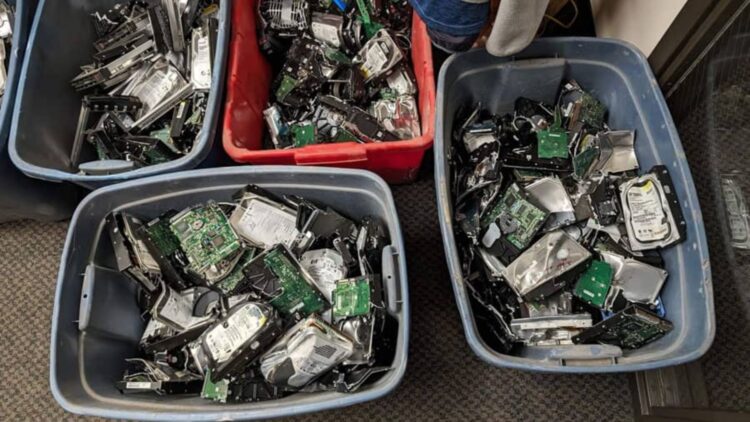
Have you ever heard about chemicals from electronic waste and its consequences? If the answer is no, we are here to tell you what a new scientific study has found: chemical substances used in tv screens, computers, and smartphones are being found inside dolphins and porpoises in the South China Sea. To better understand what’s happening, we are going to tell you more about this research, published in Environmental Science & Technology. So, let’s get started.
Liquid crystal monomers
Liquid crystal monomers (LCMs) are molecules that allow LCD screens to work properly. They help control light so we can see sharp images and bright colors on our devices. However, these compounds are chemically very stable: while that stability is useful for technology, it also means they do not easily break down in the environment. As a result, they can become persistent pollutants.
Previous studies had already detected these chemicals in indoor air, household dust, and wastewater. From there, they can travel to rivers, estuaries, and coastal waters.
The research
Until now, it was unclear whether they could move up the marine food chain and reach large predators like dolphins. But Yuhe He and Bo Liang analyzed samples collected between 2007 and 2021 from two species:
Scientists examined fat, muscle, liver, kidney, and brain tissue, looking for 62 different types of LCMs.
They discovered that four compounds accounted for most of the contamination detected. As expected with many organic pollutants, the highest concentrations were found in fat tissue. But the most surprising finding was that small amounts were also present in vital organs, especially the brain.
Most importantly, researchers confirmed that these compounds can cross the blood-brain barrier, which is the protective biological filter that prevents many harmful substances from entering the brain. This had never before been demonstrated in wild marine mammals.
How these chemicals reached dolphins and porpoises
The study suggests that the main pathway is through diet, not direct contact with water. Similar molecules were found in fish and invertebrates, which are common prey for dolphins and porpoises. This indicates that the chemicals move through the food chain. Basically, small organisms absorb the compounds, larger fish eat them, and eventually marine mammals accumulate them in their bodies.
Possible effects on marine mammals
To explore potential impacts, researchers conducted laboratory experiments using dolphin cell lines. Some of the most common LCMs altered genes involved in DNA repair and cell division.
Transcriptomic analyses showed signs of genetic damage and cell cycle arrest, which are associated with cellular stress and possible neurotoxic effects.
The authors emphasize that these findings do not automatically mean the animals are developing diseases. However, they represent a biological warning signal, especially for species already under pressure from habitat loss, ship traffic, and noise pollution.
Chemical footprint in the ocean
The study also examined changes in contamination levels over time. Concentrations of LCMs in porpoise fat increased during the years when LCD screens expanded globally. Later, levels began to decline as the industry gradually shifted toward LED technology.
This correlation suggests that global technology trends leave a measurable chemical signature in marine wildlife. Electronic waste is not only a visible environmental issue; the chemical components of our devices can travel thousands of kilometers and become integrated into organisms that have never seen a screen.
Researchers indicate that televisions and computers appear to be the primary sources of these compounds, while mobile phones contribute less. So, this is a call to think about how technology and nature intersect, and how our everyday decisions matter more than we might realize.