
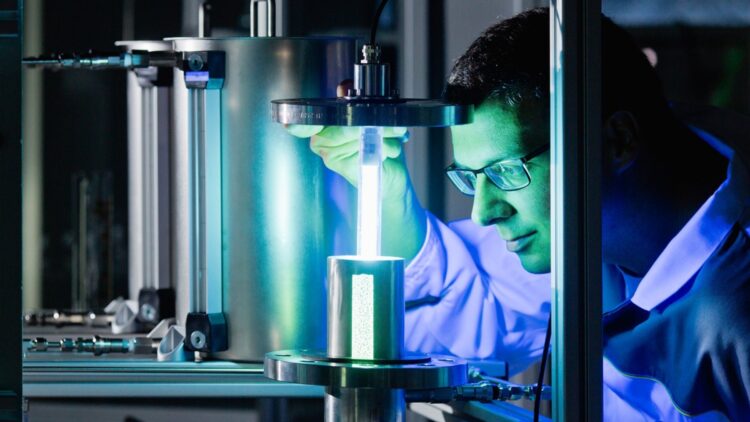
Wastewater management is one of the greatest technological and human advances in recent times. Thanks to this, we can achieve a high level of industrialization and population density while minimizing the environmental impact on the nature around us. All wastewater is loaded with heavy materials, mineral chemicals, and organic matter that would destroy the environment if we did not clean the water efficiently before releasing it back into nature.
This is why the development made by researchers at the renowned Fraunhofer Institute could greatly facilitate the management of this wastewater: a porous ceramic material that uses only ultraviolet (UV) light to purify water. Thanks to the process of photocatalysis, a technique that converts light energy into cleaning power, we could be looking at an innovation that would save us millions of dollars in wastewater treatment. Here we tell you more about the cleanest and most sustainable alternative found so far in industrial waste treatment methods.
How to clean water of micropollutants
Wastewater treatment plants, while not the pretty side of science, are essential to modern humans. They are designed to remove coarse solids, reduce the level of nutrients such as estrogen and phosphorus, and disinfect water from pathogens before it is returned to nature. However, modern humans use so many chemicals today that these traditional systems have become outdated. These microscopic residues from everyday products are called persistent pollutants, and they escape traditional filters.
The ecological impact of these micro-pollutants is devastating, as they accumulate in rivers, lakes, and groundwater. Even in countries with advanced infrastructure, this waste enters the water cycle… Even the drinking water from our taps. The most difficult enemies to combat are pharmaceutical residues: a 2023 study by the German Environment Agency detected around 40 active pharmaceutical ingredients in drinking water this year.
To this we must add pesticides, industrial dyes that resist decomposition, and microplastics that degrade very slowly. All these micro-pollutants affect the hormonal balance of aquatic life—and human life, of course.
The photocatalytic ceramic revolution
Given this context, it is normal that the ceramic foam developed by the Fraunhofer Institute for Ceramic Technologies and Systems (IKTS) is so revolutionary. Using only clinical energy, this invention is capable of purifying water without added chemicals. This means that it does not require the use of external oxidizing agents—such as ozone or chlorine—which often leave their own byproducts and have their own side effects. If implemented on a large scale, these would be cleaning agents within the water that would make the process much cleaner, more efficient, and more sustainable.
The key to this invention is its simplicity, which applies well to neuroscience. Thanks to the intelligent design of the ceramic sponge, it is a network structure with a porosity of up to 90%. This is perfect because it maximizes two factors: the internal surface area and the penetration of UV rays, which are what purify the water. This ceramic material is coated with a layer of a catalyst, such as titanium dioxide. This is how advanced oxidation photocatalysis occurs; when UV light from LEDs strikes the catalyst, it absorbs the energy.
The absorbed energy causes the release of free radicals, which are highly unstable and powerful chemical species. One of them is the hydroxyl radical, one of the strongest radicals in existence. This hydroxyl radical instantly attacks the molecules of persistent organic pollutants, converting them into inert substances. The only products that remain after the process are harmless, as they are mainly carbon dioxide and water.
For now, the research team is focusing on on-site pilot tests. If commercialized, it would be one of the most effective, economical, and sustainable industrial wastewater treatment processes in the industry to date. In a world so obsessed with the environment that it inhibits the creation of any kind of industrial fabric, this would be a ray of hope for maintaining the industrial infrastructure of the European Union.