
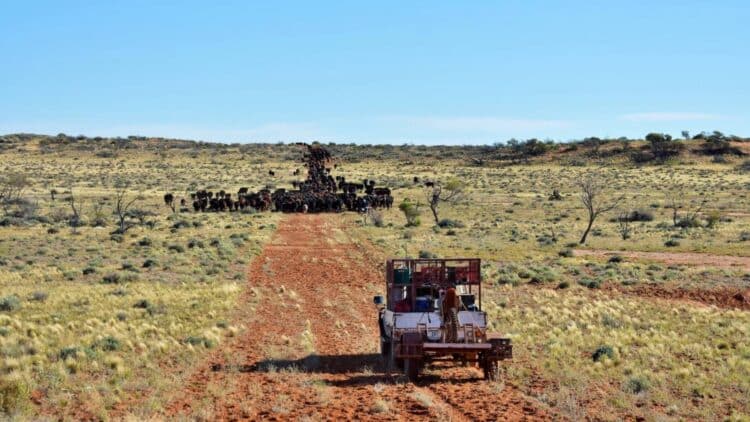
Anna Creek is not just a farm, but the world’s largest cattle ranch by area. Covering more than 24,000 km2, this cattle station spans more space than countries such as Israel. It is located in the arid interior of southern Australia—commonly known as the ‘outback’—and is owned by the family-run Williams Cattle Company.
The company is currently facing legal charges for building illegal dams and altering the natural flow of water on Aboriginal land. The complainants are the Arabana people, the traditional owners of this vast and sacred region.
Largest cattle station in the world
Anna Creek Station is the largest private farm on the planet. However, unlike the fertile ranches in America, its environment is arid and extreme, with little rainfall. That is why it focuses on quality livestock rather than mass production.
So much so that the company adjusts the number of cattle according to the rainy season; if there is a good year for rainfall, they can have a herd of between 10,000 and 17,000 head.
Instead, they focus on producing premium quality beef. So much so that Williams Cattle Company has prestigious organic certifications, such as “Never Ever Beef,” which means that the cattle have never been exposed to hormones or antibiotics. This makes it a highly sought-after product internationally; much of its production goes to processors who export it to countries such as Japan, the US, and also China.
Despite covering such a large area, this company is run by just 11 people, who use light aircraft and motorcycles to herd cattle across the Australian plains.
The Battle for Water
Water is the main resource in the desert. If you don’t have access to it, nothing else matters. That’s why the Arabana people have taken the ranch to court. The indigenous population discovered almost by accident that embankments and dams were being built on inland waterways. And it wasn’t just one or two: satellite images revealed that there were structures at 21 different sites, stretching 14.25 km, diverting the natural flow of water.
Although this may sound logical in order to ensure vegetation and pasture for livestock, human intervention has had serious environmental consequences in this delicate ecosystem. The president of the Arabana Corporation, Bronwyn Dodd, pointed out that the interruption of water killed the riparian vegetation, including the iconic Coolibah trees, on the dry side of the riverbed, leaving visible damage.
Not only does it affect the environment, but the indigenous people consider it a direct affront to their way of life in harmony with nature. The damage to these natural sites and sacred water sources constitutes a fracture to the Ularaka, their integral system encompassing the Law, the Dreaming (ancestral time and knowledge), stories, ceremonies, and spiritual ties to the land.
Possible outcomes
For now, Williams Cattle Company is facing charges under three Australian laws. The charges are under the Natural Resources Management Act, the South Australian Landscapes Act, and, most importantly, the Aboriginal Heritage Act. This is the first time charges have been brought under the Aboriginal Heritage Act against a commercial entity in the livestock sector.
Previously, there was the Juukan Gorge scandal in 2020, where a mining company destroyed sacred ancestral caves. For this cattle station, court hearings are scheduled for the first week of November.
The law in force when the alleged events took place (between 2017 and 2025) limits the maximum penalty for damage to heritage to AUD 50,000—compared to AUD 2 million under the new legislation. In addition, the plaintiffs want to force remediation of the damage. That is why they have asked the court to order the removal of the dams and the restoration of the damaged sites in an attempt to reverse the ecological and cultural damage.