
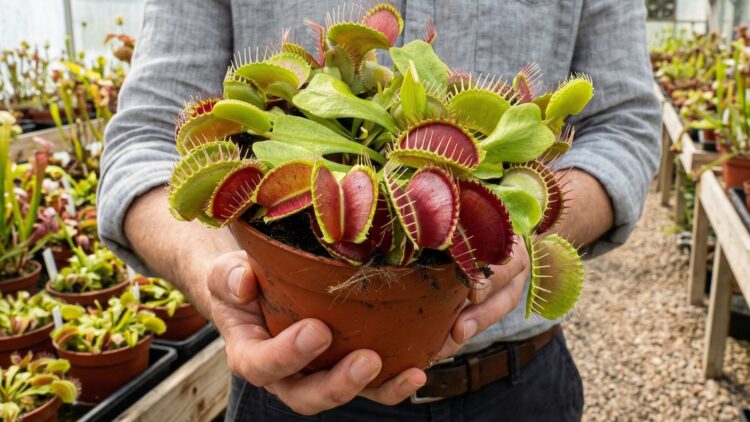
You really have to slow things down to catch the nightmare unfolding as a carnivorous plant does its magic. As soon as a fly brushes against the open leaves of a Cape sundew, it gets grounded immediately. The bug is stuck. A thick, sticky slime holds it right where it is. Fighting back is useless. Usually, thrashing around to break free just pushes the snack into even more of the glue. Inch by inch, the leaf wraps around the insect, hugging it tight like it owns it, while digestion starts up.
It is easy to feel sorry for the small bugs that end up as lunch for hunters like the Cape sundew, Venus flytraps, and pitcher plants. Something that looks like a harmless piece of scenery suddenly turns into a prison with no exit.
Man-eating plants, and other myths
This concept grabbed our imagination so much that man-eating plants are a classic trope in science fiction, even if real ones feel like ancient monsters that belong in the dinosaur age. The truth is, these plants have been around for millions of years, always surviving by pulling nutrients from animal prey because the dirt they grow in just doesn’t offer enough.
While most of these meat-eating species are tiny, the wide range of trap styles triggers a question about their development. Why didn’t they ever get massive enough to challenge the people-eating monsters we keep inventing in stories?
Plants generate their own sustenance. It is a fundamental lesson most of us pick up early: photosynthesis is the biological trick that lets vegetation use sunlight to power its own growth and keep the world green. However, there are always outliers, and certain plants require a bit more help than what they can get from just sunshine or dirt. A few species have cravings that only meat can satisfy, a necessity they have developed solutions for repeatedly over millions of years.
Real life giants
Schmidt notes that if you look at sheer size, West Africa is home to one of the biggest carnivorous plants on Earth. This species, Triphyophyllum peltatum, grows as a woody vine that can extend over 160 feet, using sticky glands along its length to snag insects. However, Schmidt explains that it only acts as a predator during its younger years while spreading across the forest floor.
Although Borneo’s Nepenthes rajah is substantial enough to capture frogs, lizards, and small vertebrates, its pitchers only reach a depth of sixteen inches—an amazing feat for a plant, yet far smaller than the giant, people-eating triffids found in science fiction.
Flytraps, sundews, pitcher plants, and similar hunters have flourished for millions of years by trapping tiny meals and forming bonds with animals that provide otherwise unreachable nutrients. Even though the planet is full of massive creatures, these plants evolved to target small prey simply because of the demands of their specific habitats.
The bigger, the better?
Sadowski notes that these predatory plants already live in places where the dirt lacks nutrients. They developed their different traps to eat animals simply because they can’t pull enough sustenance from their surroundings. Eating meat is basically a shortcut that lets them survive right where they are.
Even ignoring the physical challenge of building a trap strong enough to hold larger beasts, a giant plant would need rich soil to reach that size, and if it had access to good earth, there would be no point in hunting for food in the first place.
At the end of the day, plants aren’t consuming animals just for the fun of it. This strategy is a brilliant fix that helps them survive in places where they would normally have a hard time. There is no incentive for them to reach movie-monster proportions because they are already pushing the limits of survival, stealing what they lack from a different branch of life while they cluster in the planet’s marshes.