
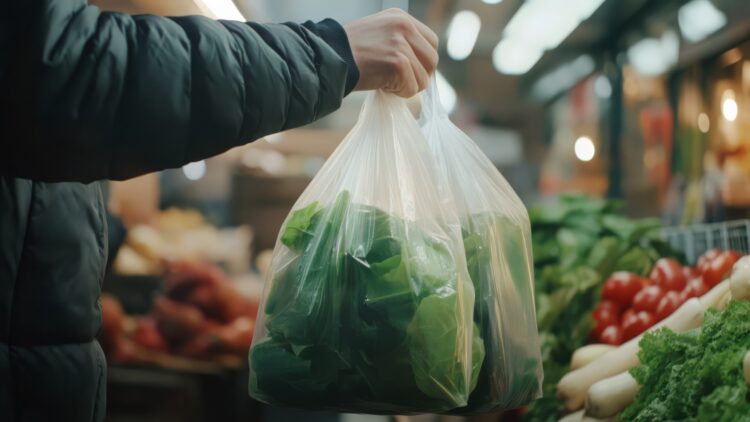
Starting next year, doing groceries in Illinois might prove a bit cheaper—yes, even with the galloping inflation. Californiansz, on the other hand, might have to deal with the lack of free plastic bags. (But hey, are you even allowed to live there if you don’t own artisanal crocheted net bags to hold your organic produce for the week?)
As we were saying, Illinois and California will roll out two massively different pieces of legislation on the exact same day. One law wants to keep money in. your wallet… the other wants you to bring your own reusable bags if you care remotely about our lovely planet Earth. Here we will tell you all about these laws that, even if they are unrelated in nature and are held 2,000 miles away, will change the way people experience the checkout line at their favorite grocery store.
The new law in Illinois
Under the newly enacted Public Act 103-0781, the state of Illinois is eliminating its statewide grocery tax. This tax relief will eliminate the 1% state tax that was applied to food. Governor J.B. Pritzker signed this bill into law back in August 2024. “Taxing food is regressive”, argued the Governor, since it’s a basic need, and poor families spend a much higher percentage of their monthly income on feeding their domestic household, therefore they are more heavily taxed that other more financially comfortable families.
The suppression of the 1% tax on food would save each family about $130 a year, which means a lot when the economic landscape leaves little discretionary income at the end of the month.
However, this 1% food tax did not start as an evil imposition. It was actually a reducttion—or better said, tax reform—back in 1990. Before this year, food was taxed at a much higher rate, similar to clothing or electronics. The 1% tax was a reduction that has lasted for more than 35 years.
…But there is a catch—as with everything. This 1% tax didn”t go straight to the state, but it was used to fund local governments. Public services such as the local police department, road repairs, and public parks were funded thanks to this food tax. Which is why the new laws has given the local governments the power to create their own. If the tax elimination leaves a massive revenue hole in local administration, they are allowed to create a 1% “Municipal Grocery Tax” without needing to ask voters for permission.
So now, most Illinois residents will face an Schrödinger grocery bill; it can be taxed with a 1% municipal tax—or not. We will have to wait to see until January 1, 2026.
However, the bill will specify strictly who are you paying this tax to. Shoppers must remember that only food for home consumption is taxed at 1%; things like alcohol, soft drinks and candy still pay the full tax rate. Hot food prepared for immediate consumption (like a rotisserie chicken) also remains fully taxed.
Apart from Illinois, Alaska will be eliminating its state grocery tax on January 1, 2026.
California laws
God Forbid California goes without any taxes. No, it’s too blue a state to do that. Instead, California is implementing Senate Bill 1053 (SB 1053), which takes effect on January 1, 2026, which enacts a total ban on all kinds of all plastic shopping bags at the checkout line. This is after a decade-long battle with jurisdiction and wording of legislation.
In 2014, California passed SB 270, which banned thin, single-use plastic bags… which incentivized stores to sell thicker, heavy-duty plastic bags for 10 cents. After all, these bags were “reusable” and durable enough to be used dozens of times. However, Americans love convenience above all, and the average Joe has been programmed for decades not to bring its own bags to the grocery store… which lead to clients simply purchasing plastic bags every time they shopped.
Because the new bags were made of much heavier plastic, the total weight of plastic waste actually increased (oh, the irony!). State data showed a staggering 47% increase in plastic bag waste by weight after the 2014 ban. SB 1053 is designed to close that loophole permanently. We all know it will… we just don’t know exactly how yet.