
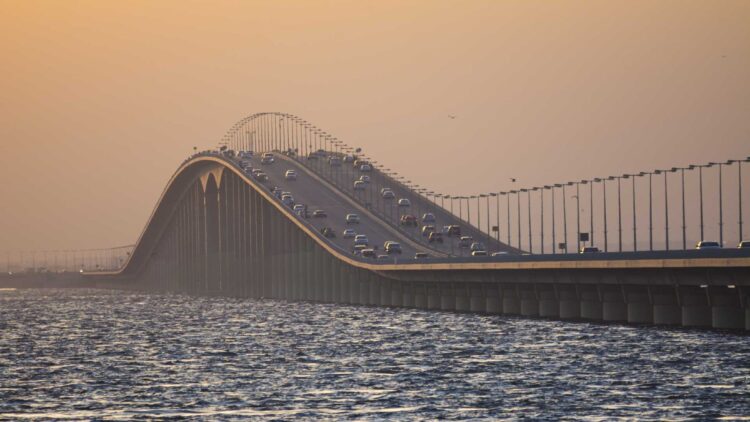
The world is so vast and full of wonders that not all of them are known. One of these is the King Fahd Causeway, an international road bridge between Al Khobar in Saudi Arabia and Al Jasra in Bahrain, stretching some 25 kilometers across the Bahrain Gulf. This impressive $2 billion megabridge spans the sea, connecting the two nations. The structure rests on more than 500 concrete piers and links the two countries via several artificial islands that house border stations and rest areas. It’s a structure that opened in 1981, yet few people know about it.
The route runs over the water, offering views of the surrounding sea
The King Fahd Causeway allows drivers to cross the Gulf of Bahrain by road. The central island offers a palm-fringed rest stop with pavilions where travelers can pause briefly between the two countries. The route runs over the water, offering views of the surrounding sea, and stands as one of the most important land connections between the two nations. In this way, Saudi and Bahraini influences blend in the cuisine and the design of rest areas in this part of the world.
The infrastructure consists of five bridges and seven levees, includes four traffic lanes and one emergency lane, and has a total length of 25 km (15.5 miles). It’s important to note that border control can be lengthy depending on traffic and time of day, so traveling off-peak helps reduce waiting times. The entire journey by car typically takes between 20 and 45 minutes. All vehicles pass through customs and immigration controls on the artificial islands along the route.
The causeway was named in honor of the then Saudi king
Going back in time, construction began in July 1981 following an agreement between the two countries and continued until its official opening in November 1986. The causeway was named in honor of the then Saudi king, who passed away in 2005. Since then, the structure has connected the two states by land and has radically transformed trade and travel in the region. When it entered service, the project forced Bahrain to change its traditional direction of traffic, as Saudi Arabia drives on the right, while Bahrain had previously driven on the left. Despite the dates mentioned, the idea for the causeway arose much earlier, in 1954, after King Saud bin Abdulaziz Al Saud visited Bahrain.
The moment the need for a maritime connection between the two territories became apparent, the idea was set in motion. The artificial islands along the route serve not only as border posts but also offer one of the few opportunities to stop in the middle of the gulf and take photographs. The causeway was designed with a planned lifespan of 75 years, with a projected completion date of 2061, although there are initiatives to extend its operation.
Since 2018, women have been allowed to drive on this route
This bridge is becoming increasingly well-known, so much so that tourism and travel companies are promoting it as a must-see destination for anyone visiting the area. “Round trip from Kuwait to Bahrain, driving approximately 400 kilometers through Saudi Arabia and the King Fahad Causeway, 25 km across the Gulf, offering an incredible journey,” online portals describe it. Another unique feature is that since 2018, women have been allowed to drive on this route following the lifting of the ban on women driving in Saudi Arabia.
It is, therefore, an unprecedented construction. The bridge offers the experience of traveling across the sea without having to board a ship or endure any dreadful seasickness. On some days, dolphins can even be seen swimming in the shallow waters from the bridge, according to witnesses. And finally, as a curious fact, the island in between also has a border station with a McDonald’s on each side. As George Ritzer would say, the McDonaldization of society.