
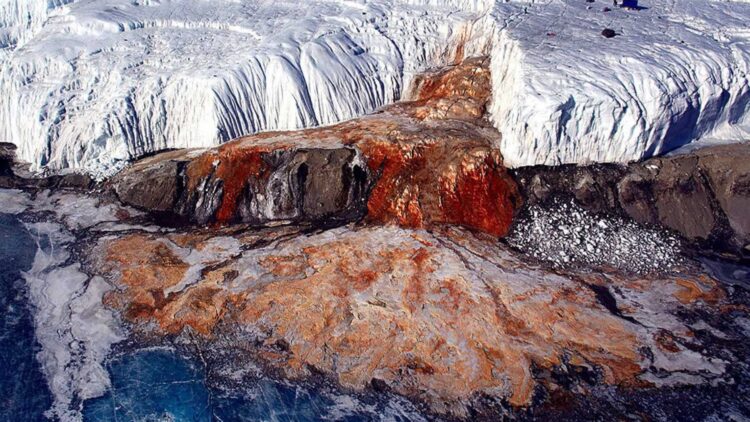
In Antarctica, there’s a natural phenomenon that, for more than a century, has surprised scientists and explorers: an intense red flow of water pours out of the ice, looking almost like blood spilling onto the frozen surface. This place is known as Blood Falls and it’s found in the Taylor glacier, in Antarctica’s McMurdo Dry Valleys.
Now, researchers have solved this old mystery when they discovered the red water was related to pressure changes and movements hidden under the glacier. So, let’s find out more about what they discovered.
How scientists solved the mystery
In September 2018, scientists used a sensor placed on the Taylor glacier and it registered a small drop on the ice’ surface right when a camera captured the beginning of the red flow. Geoscientific Peter T. Doran, from the Louisiana State University (LSU), carefully compared the data and he found that the drop in the glacier’s surface matched the timing of the red outflow and was connected to a decrease in pressure beneath the ice.
Over several weeks, researchers observed that the glacier surface sank slightly and then later returned to its previous level. This showed that a short-lived drainage event had taken place under the glacier. When trapped water drains away, pressure beneath the ice decreases. At the same time, the glacier slowed down by nearly 10 percent and this happens because water beneath a glacier normally helps it slide more easily over rock. When some of that water drains out, the ice presses harder against the ground, making it move more slowly.
Scientists described this as a rare and valuable moment because camera images, glacier surface measurements, and temperature readings from a nearby lake were recorded at once.
Is it blood?
You might think this water color is blood, and its name would make sense. However, the red color is caused by iron in the brine, so when the liquid reaches the surface and comes into contact with air, the iron reacts with oxygen. This chemical reaction, called oxidation, is what turns the water rust-red within minutes.
Tiny iron particles form in the salty water underground and, once exposed to air, they stain the ice as the flow spreads downward. This rapid color change makes each discharge easy to see, helping scientists track when the hidden system beneath the glacier opens.
Where does the red water come from?
Under the glacier, there’s a network of hidden channels filled with extremely salty water known as brine and because of its high salt content, this water can remain liquid even in temperatures far below freezing. The immense weight of the ice traps this brine under pressure, but the glacier cannot hold that pressure forever. So, when stress builds up too much, the system releases the brine in sudden pulses.
Airborne sensors have detected deep salty water beneath the valley floor, even far from any melting ice. These signals suggest that the brine can travel through underground pathways at least three miles long before entering the glacier.
Later, researchers used ice-penetrating radar to map brine channels within the glacier itself, stretching across several miles of ice. These maps helped explain why red outflow appears at certain cracks, while other brine flows quietly into the nearby lake.
To sum up
Blood Falls shows us something important: even though Antarctica looks completely frozen and still on the surface, there is a lot happening underneath the ice.