
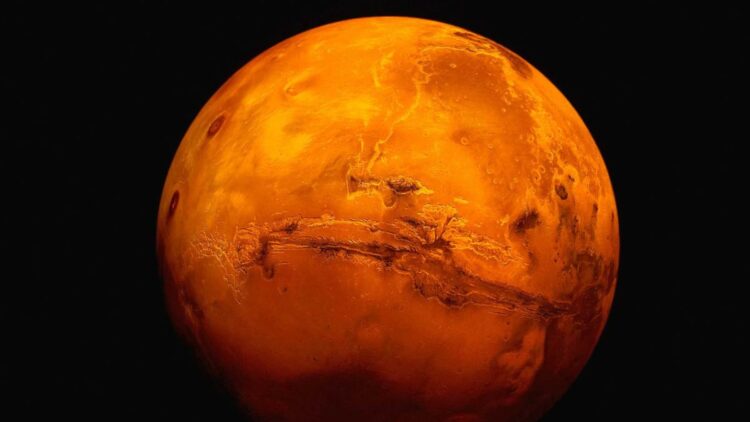
Scientists have scanned a popular rock from Mars and they found something surprising. The meteorite, known as Black Beauty or NWA 7034, is a fragment from Mars that reached Earth after a huge impact against the Red Planet. It is estimated that it’s about 4.48 billion years old, which makes it one of the most ancient Martian materials in the solar system.
To study it, scientists had to cut, crush, or dissolve parts of the rock, which destroyed part of its structure. However, now it is possible to explore these unique rocks without damaging them thanks to new scanning technologies. So, let’s learn more about what scientists discovered about this rock.
New technologies
The research team, led by Estrid Naver from the Technical University of Denmark and her co-authors, used two types of computed tomography (CT) scanners to examine Black Beauty. CT scans are similar to the machines used in hospitals but adapted for meteorites. For example:
- X-ray CT: This scanner is very effective at detecting heavy, dense materials like iron or titanium.
- Neutron CT: Less common, this type uses neutrons instead of X-rays. It can penetrate dense materials and detect hydrogen, an important element for finding water.
Using these tools, the scientists were able to study a small, polished sample of Black Beauty without breaking it, revealing details that were previously hidden.
Discovering hydrogen-rich clasts
Inside the meteorite, scans revealed clasts, which are small fragments of rock inside a larger one. Even though scientists already knew that the Black Beauty was formed by clasts, the scans identified a new type called Hydrogen-rich Iron oxyhydroxide (H-Fe-ox).
These fragments represent only 0.4% of the sample volume, but contain about 11% of the total water in the sample. In total, the Black Beauty has around 6,000 parts per million of water, which is a very high amount considering that Mars has little water now.
This finding is important because it complements the samples collected by the Perseverance rover in Jezero Crater. Although the Black Beauty comes from another Mars region, both show that liquid water was widespread on the planet billions of years ago.
Why is Black Beauty like a Mars sample mission?
Black beauty works like a sample return mission in a single rock, giving scientists a chance to study Mars material without needing to send a mission. The research team hopes to apply these non-destructive CT techniques to future Mars Sample Return mission rocks. CT scans can even analyze samples inside their titanium containers, preserving them perfectly.
Although a recent Mars Sample Return mission was canceled, other missions, such as a planned Chinese return mission, may still bring back Martian rocks. In the meantime, studying meteorites like Black Beauty on Earth remains a valuable way to learn about Mars.
Importance of Mars water discoveries
These findings tell us more about the history of water on Mars. The hydrogen-rich clasts suggest that billions of years ago, Mars had liquid water on its surface, which is a key factor for understanding the planet’s past environment and its potential to support life.
By using advanced scanning techniques, scientists can now uncover hidden features in Martian rocks without destroying them. This allows researchers to maximize the scientific information from every sample, even small fragments the size of a fingernail.
To sum up
We know Mars is one of the most studied planets, but the Black Beauty reminds us that even the quietest rocks can hold surprising secrets about the Red Planet. Isn’t it incredible the many places scientists can find new evidence about different events? Let’s hope next discoveries uncover even more secrets about Mars.