
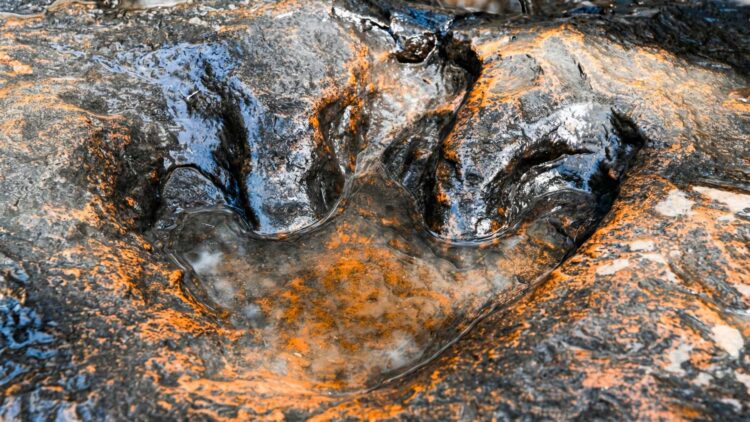
Scientists have spotted a record-breaking 21 distinct kinds of dinosaur footprints along a 25-kilometer piece of the Dampier Peninsula coast, which people are calling “Australia’s Jurassic Park.”
Experts from the University of Queensland and James Cook University dealt with sharks, crocodiles, dangerous tides, and potential construction plans to reveal the planet’s most varied collection of dinosaur footprints, preserved in rocks aged 127 to 140 million years old in Western Australia’s isolated Kimberley region.
Dr. Steve Salisbury, the lead researcher, explained that the mix of tracks near Walmadany (James Price Point) is unmatched anywhere else, essentially making the area the Cretaceous version of the Serengeti.
Dr. Salisbury added that this site is incredibly important because it serves as the main record of dinosaurs (other than birds) in the west and offers our only look at the animals living in Australia during the early part of the Cretaceous timeframe.
“It’s a really magical location—basically Australia’s own Jurassic Park, sitting in an amazing wilderness area.”
Fighting back against a gas plant
Back in 2008, the Western Australian government picked Walmadany as their top choice for building a $40 billion liquid natural gas plant.
The Goolarabooloo people, who are the traditional guardians of the land, reached out to Dr. Salisbury and his group, and they spent over 400 hours studying and recording the footprints. Phillip Roe, a Goolarabooloo Law Boss, explained that they had to let the world see exactly what was at risk of being lost.
These fossil footprints are connected to a song cycle that runs down the shoreline and goes 450 km inland, following the path of Marala, the Emu Man, a creator spirit from the Dreamtime.
Mr. Roe explained that Marala was the Lawgiver who set down the rules for the land that they still need to follow, teaching them how to behave and keep everything in balance.
He added that it was wonderful working with the university researchers because both groups learned so much from one another.
Dr. Salisbury mentioned that the political tension nearby made the project incredibly stressful, so he was relieved when the site earned National Heritage protection in 2011 and the gas project eventually fell apart in 2013.
A Guinness record for dinosaur footprints
Dr. Salisbury noted that while there are thousands of prints around Walmadany, they could definitely link 150 of them to 21 specific patterns that represent four major groups of dinosaurs.
The collection included five kinds of tracks from predators, at least six from long-necked plant-eaters, four from plant-eaters that walked on two legs, and six from armored dinosaurs.
“The prints include the only sure proof that stegosaurs lived in Australia. They also include some of the biggest dinosaur footprints ever seen, with some sauropod tracks measuring about 1.7 meters long. Most dinosaur fossils in Australia are found on the east coast and are typically between 90 and 115 million years old, but the tracks here in Broome are much older.”
The findings were released as the 2016 Memoir of the Society of Vertebrate Paleontology.
What will happen with the area now then?
Before 2008, outsiders barely paid attention to the area, even though Indigenous locals had known about it forever. The Goolarabooloo people had woven these track sites into their songlines, which effectively store information about the geology, nature, and ceremonies along trails in the landscape. Scientists only started looking closely when plans were made to build a gas processing plant at James Price Point, a crucial part of the reef where the tracks are found.
In response, the Traditional Custodians asked for expert fossil studies to help save the coastline. Those efforts led directly to the area being placed on the West Kimberley National Heritage List in 2011. The footprints turned out to be key evidence in the successful fight to stop the $40 billion gas project.
This series of events also became one of Australia’s first big examples of Indigenous leaders managing fossil heritage in partnership with academic researchers.
Visiting these sites still requires permission from the community. The research was done right there with local custodians present and followed their cultural rules. The findings showed that many of the track types match details from cultural legends, such as Marala (the Emu Man), whose three-toed footprints line up with the ones scientists call Megalosauropus.