
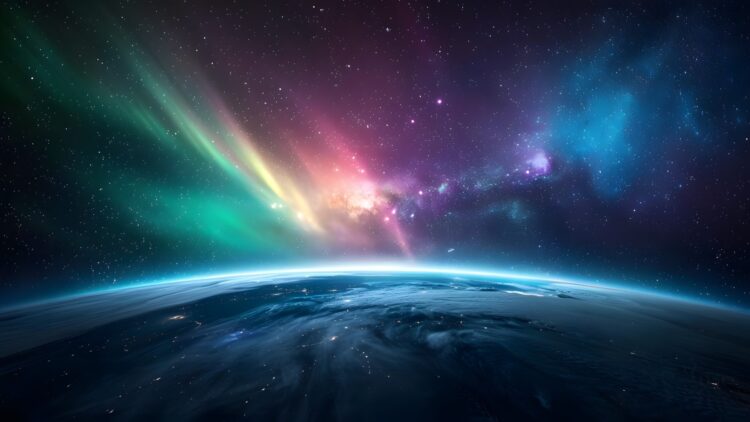
It’s Northern Lights season. If you’ve never had the chance to see a night sky where green, pink, and purple dance in ethereal waves, you may be in luck. According to the National Oceanic and Atmospheric Administration (NOAA), there will be a solar wind event in the coming days that will cause a minor storm, not powerful enough to push the Northern Lights to a much lower latitude than usual.
In the middle of the week, geomagnetic activity is expected to reach a Kp 4 level, which will make it visible in the northern states of the US. From the Pacific coast to New England, this aurora borealis will likely be visible.
How the Northern Lights happen
Although it may seem like magic from the mythological gods of Norway, it is physics at its finest. The sun that warms our planet is nothing more than a giant particle engine, constantly ejecting a stream of charged particles (solar wind) into space. Fortunately, the Earth has an “invisible shield” that allows us to live on it: the magnetic field. This field acts as a protector, deflecting most of the dangerous solar particles.
However, when the solar wind is supercharged by an eruption—or a coronal hole—this charge hits our magnetic field with such force that some particles manage to slip through. They enter through the two weakest points in the shield, the North and South poles.
You know, the particles penetrate and collide at high speed with the gases present in our atmosphere—mainly oxygen and nitrogen. This collision transfers energy, causing the gases to become “excited” and release that energy in the form of light. The result is the famous undulating curtains of light that we see on some nights. The most common color, emerald green, is due to collisions with oxygen at an altitude of about 100 km.
What does Kp 4 mean?
If you’ve never hunted for northern lights (a very poetic hobby), knowing the Kp index is a very useful tool. The Kp index is the “temperature” gauge we use to calculate how disturbed the Earth’s magnetic field is by solar activity. It ranges from 0 (calm skies) to 9 (extreme geomagnetic storm that can damage all of humanity’s technological infrastructure).
A low Kp—0 to 3—means that the northern lights will only be visible in Alaska and northern Canada. But a Kp of 4, the current alert level, means “Active” activity. This is why many fans of this phenomenon are excited about the NOAA warning. The announced Kp is 4, but with peaks expected to reach 4.67 (almost G1) for periods of three hours. In other words, the storm is strong enough to guarantee a spectacular show, although with the peaks it will be possible to see the northern lights in northern latitudes of North America.
When can we see the Northern Lights?
NOAA alerts are dynamic, so the window of opportunity opens now and remains open during peak geomagnetic activity. The ideal time for viewing is in the middle of the night, when the Earth is furthest from the sun’s light (if you wanted an excuse to stay up all night gazing contemplatively out the window, here it is!).
The most likely peak Kp 4 activity was forecast to occur between 10:00 PM and 3:00 AM local time in your time zone, with peak intensity gravitating around midnight or 1:00 AM.
The states most likely to see the lights are North Dakota, Minnesota, Wisconsin, Michigan, Maine, Montana, Idaho, Washington, and South Dakota. Remember to look north when searching for the aurora borealis.
Sightings in Canada
Our Canadian neighbors have a better chance of seeing the Northern Lights. Visibility is high in the northern provinces (Yukon, Northwest Territories, Manitoba), but it can also extend south to Quebec and Ontario, especially away from city lights.