
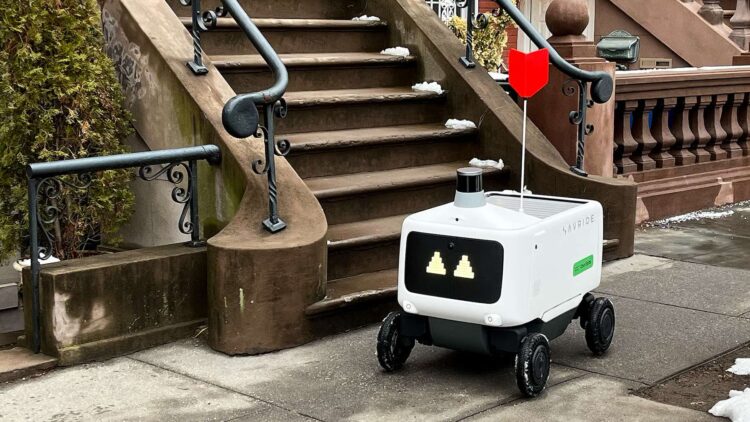
Artificial intelligence (AI) is reaching more aspects of our lives, we see it everywhere. However, it’s no longer just about programs on computers or experiments in labs, but also used in real robots, fabrics, warehouses, and public spaces. This is exciting, but it also represents great challenges.
To make artificial intelligence work in robots, companies need new systems and technological infrastructure, including powerful computers, fast networks, and systems that can handle huge amounts of data from sensors, cameras, and robots moving in the real world. So, let’s find out more about this
Why artificial intelligence needs a new infrastructure
Physical AI is different to the traditional one. While models like large language models (LLMs) can learn from internet text, robots need context-specific data such as:
- Motion and position data.
- Photos and videos.
- Sensor readings like LiDAR.
This data must match the real actions and outcomes of the robots. Collecting it only in the real world is slow and expensive, which is why simulations—virtual environments that mimic real-world conditions—are crucial. Basically, simulations allow teams to test robots, create synthetic data, and try different scenarios faster than using only real robots. To make these simulations possible, companies must manage:
- Optimizing speed for massive numbers of tests rather than just fast results.
- Thousands of GPUs working together.
- Preparing 3D assets ready for simulation.
Hardware reliability is also critical because if one GPU fails, it can disrupt an entire training cycle. So, choosing the right cloud system for simulation requires balancing price, performance, and reliability.
Managing big data and low latency
Once robots are developed, they produce huge amounts of data, like:
- Sensor readings from LiDAR and motion.
- Video from cameras.
- Simulation outputs.
Not all this data is easy to use. Unlike clean datasets used to train traditional artificial intelligence, this information is messy, time-sensitive, and highly contextual. Teams need systems that organize, index, and synchronize data so it can be used effectively for training and improving AI models.
Latency, or the time it takes for a system to respond, is critical. Physical AI must react in milliseconds, which means centralized, slow processing is not an option. Instead, AI systems must combine:
- Cloud-based systems for planning and coordination.
- Fast, on-device processing for immediate actions.
Data movement
One of the most challenging things about physical AI is moving data quickly and efficiently. Robots produce continuous streams of video, motion, and sensor data, and many current systems are designed for batch processing, not real-time, high-volume flows.
Simply adding more GPUs is not enough if data cannot move between devices, local systems, and the cloud efficiently. Transferring large volumes of data can even cost more than storing it. For AI in robotics to scale, infrastructure must:
- Support fast read and write speeds.
- Have high-bandwidth pipelines.
- Maintain predictable throughput.
Nebius company
Companies like Nebius are building systems designed for this new era of AI. Their infrastructure combines:
- Flexible orchestration systems to manage simulations and real-world workloads.
- High-performance GPUs.
- High-speed storage.
This allows AI teams to train, simulate, and deploy robots faster and more reliably, whether for massive simulations or real-world applications. The focus is not only on raw computing power but also on data movement, speed, and coordination across virtual and physical worlds.
So…
If you are interested in robotics or work with artificial intelligence, these changes are important for you. Physical AI doesn’t work like traditional AI: robots need to process data quickly, react instantly, and continuously learn from the real world. How fascinating the artificial intelligence world is, right?