
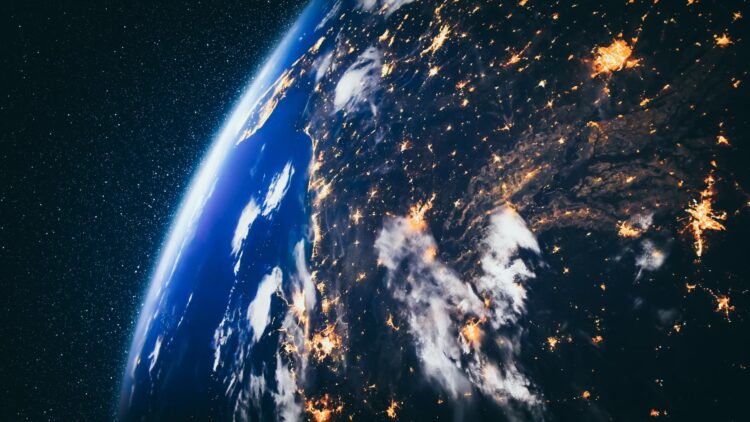
Before smartphones and all the apps that steal your attention—and rot your brain in the process—people used to sit around thinking and speculating about impossible hypothetical scenarios. What would happen if the Earth suddenly had zero gravity? What if the sun went out instantly? These questions, while not keeping us awake at night, do entertain us when our cell phone battery dies and we have to spend time with ourselves.
However, a team of researchers has gone further and studied what would happen if every light bulb, streetlight, and light on our planet Earth suddenly turned on at the same time. This is a model rendered by engineers and scientists to calculate the massive stress on the global power grid and what would happen to our night sky. Would we be blinded by so much light? Would the power grids of every country on Earth fry, leaving us without electricity for months while we repaired them? Here we tell you everything.
The Electric Grid under Pressure
To understand how the electricity we comfortably use in our homes works, we first need to understand that it is produced in power plants. The electricity generated must be equal to the electricity consumed by homes and businesses at all times. This balance is the essence of grid stability, and the total volume of consumption is known as the “load.”
When demand suddenly exceeds supply, the grid frequency drops, and safety systems kick in. These systems automatically disconnect generators to protect them from catastrophic damage, which is what happens when there is a massive blackout in the affected areas—as happened last April in Spain.
Ironically, without instantly turning on all the lights on the planet, this would create a tsunami of demand that would far exceed the immediate response capacity of any plant. The fact is that base load power plants such as nuclear and carbon plants are slow to adjust their production. In fact, grid operators rely on natural gas plants and storage systems (such as pumped hydroelectricity) to inject electricity quickly.
However, simultaneous global demand would overwhelm any rapid response capacity, as this level of demand has never been seen before in the history of electricity.
From an ecological point of view
From an electrical engineering perspective, the most traumatic consequence would be visual and ecological. Light pollution would skyrocket to such an extent that we would not be able to see any stars (and barely the moon, unless it was a full moon).
This is because artificial light, even when it shines reflectively on the ground, hits moisture particles, dust, and soot in the atmosphere. These particles scatter light in all directions, creating a diffuse glow that makes it almost impossible for us to see celestial bodies beyond our atmosphere.
This would confuse nocturnal wildlife: migratory birds, insects, and sea turtle hatchlings depend on the light of the moon and stars to navigate. Not only would it disrupt the biological rhythms of humans who do not have blinds, but the behavior patterns of much of the fauna would be affected, causing disorientation that would lead to widespread stress in ecosystems across the planet.
Real situations of electric stress on the grid
Although we have never experienced a situation where electricity is required for every light bulb on the planet—and we hope we never will—there have been times when electricity grid operators have faced synchronized peaks in demand.
One of the best-known cases is the “TV Pickup” phenomenon in the United Kingdom. Brits are famously known for loving their cuppa tea, and they will rush to their electric kettles for a fresh batch during important football match intermissions. If a regular electric kettle needs approximately 3 kW, the surge in demand can reach peaks of more than 2,800 MW instantly.
In the United States, the Super Bowl causes a similiar problem with water pumps. The synchronized use of bathrooms during breaks means that all cities have to be careful with water pressure while Americans take advantage of the opportunity to go to the toilet…in unison.