
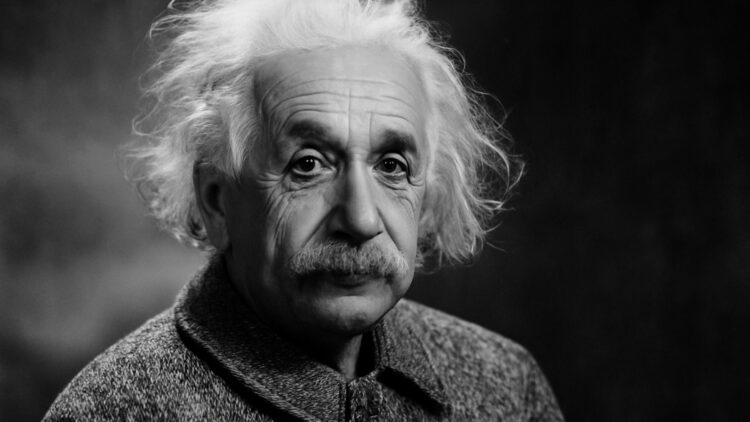
Albert Einstein must be the most iconic figure in the scientific world. When we think of geniuses, Isaac Newton, Nikola Tesla, or even Copernicus come to mind. However, the face that appears on most T-shirts, merchandise, and coffee mugs is that of the German physicist. We associate the face of this adorable old man sticking out his tongue mockingly with relativity, quantum physics, and the most famous formula in the world, 𝐸=𝑚𝑐2.
But beyond the equations, the real driving force behind his discoveries was a philosophy of life worthy of a pure humanist. His greatest lesson for humanity may not have been his scientific work, but his vision of the creative mind. In his own words, the key to Albert Einstein’s genius was not based on his vast knowledge, but on his unlimited ability to imagine things never before seen or written about in books.
The famous—but inaccurate—quote about logic
You may have read this quote on a Facebook wall. It is a fairly concise summary of what Albert Einstein believed:
“Logic will get you from A to Z; imagination will get you everywhere.”
This phrase attributed to Albert Einstein has been widely circulated on social media and in books, but it is an attribution without a verifiable source. It is a modern paraphrase that perfectly sums up the German physicist’s thinking, although he never said—or wrote—it in exactly these words. Throughout his life, his true statement was more profound and revealing.
Albert Einstein’s real quote about the value of imagination over knowledge came from a historic interview. It was a conversation with journalist George Sylvester Viereck, published on October 26, 1929, under the title “What Life Means to Einstein” in The Saturday Evening Post.
When the interviewer asked him about his thought process, Mr. Albert Einstein responded with this memorable answer:
“I am enough of an artist to draw freely upon my imagination. Imagination is more important than knowledge. For knowledge is limited, whereas imagination embraces the entire world, stimulating progress, giving birth to evolution.”
For Albert Einstein, imagination and knowledge were not opposing forces, but rather intertwined components of a hierarchical engine. While knowledge is a collection of facts, rules, and data that have already been established and verified, imagination is progress, necessary for conceiving what is not yet real, everything that challenges the facts in existing rules. Thanks to imagination, we have the necessary mechanisms to perform mental experiments. Thanks to imagination, Einstein conceived relativity by imagining what would happen if he traveled at the speed of light, which was totally impossible according to the knowledge of physics at that time.
Without imagination, humanity remains stuck repeating what it already knows; with imagination, we create what others can learn tomorrow. Thanks to visionaries such as Albert Einstein and Leonardo DiCaprio, we have a knowledge base from the past that, with today’s professional technology, we can use to create a future for the next generations. Leonardo da Vinci, for example, was able to draw up plans for helicopters, but he was limited only by the lack of materials and technologies needed to build them.
Lessons from the 1929 Interview
Apart from talking about imagination versus knowledge, Mr. Albert Einstein clarified many doubts that the general public had about the 1920s. At that time, society interpreted his relativity as a justification for moral chaos. Mr. Einstein was quick to correct this, telling the interviewer that his theories were about physics, and that he did not meddle in the spiritual world or assume that “the world should be turned upside down maliciously.”
In fact, he confessed to his determinism—that is, not believing in free will—and acknowledged the need to act respectably in society, going so far as to say, “I would rather not have tea with a murderer, for example.”