
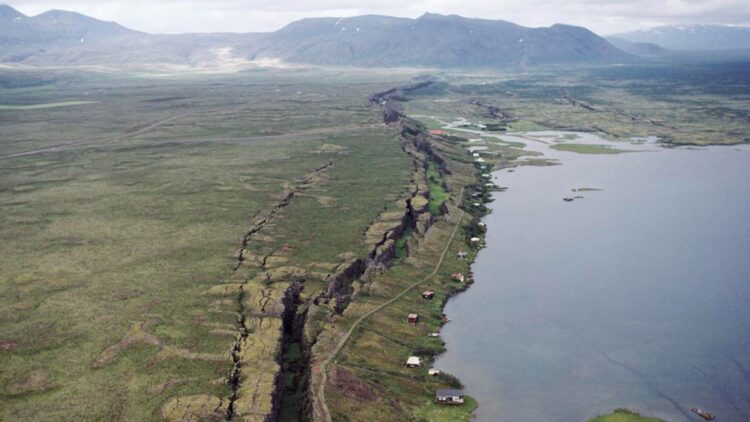
Africa is slowly changing in front of our eyes, although we can’t see it directly. Scientists have discovered the continent is splitting in two parts, and millions of years from now, this crack will create a new ocean. This process is happening in an area called East African Rift (EAR) and affects mainly the east side of Africa, known as the Somali Plate, which is slowly moving away from the rest of the continent, known as the Nubian Plate.
Although this process is extremely slow—only a few millimeters each year—it already has visible effects in the region. Areas like Afar, Ethiopia, are unique in the world because they contain a rare triple junction, where three major tectonic rifts meet: the Ethiopian Rift, the Red Sea Rift, and the Gulf of Aden Rift. So, let’s learn more about what’s happening.
Africa is splitting
The movement of tectonic plates is very gradual. The Somali Plate is separating from the Nubian Plate, while both are also moving away from the Arabian Plate in the north. This creates a giant “Y” shape in the Afar region. Let’s see some important points about this process:
- The plates are moving apart at roughly 0.28 inches (a few millimeters) per year, so it will take millions of years to form a complete ocean.
- Some areas of Afar are already very thin, and parts are below sea level. Eventually, seawater will flow in to form a new ocean between the separating plates.
- The northern part of the rift is moving fastest, so new oceans will form there first, according to geophysicist D. Sarah Stamps from Virginia Tech.
Beneath Earth
The Earth is formed by tectonic plates floating on a layer of molten rock called the mantle. In the Afar region, there’s a phenomenon called mantle plume, a column of hot rock rising from deep inside the Earth. This plume is helping to break apart the crust.
Recent research, including studies published in Nature Geoscience, shows that the mantle here is not static. It pulses like a heartbeat, sending up molten rock with distinct chemical signatures. These pulses rise through the cracks in the Earth’s crust and push the plates apart.
Geologist Emma Watts, lead author of the study, explained that these rising pulses are crucial for understanding how the interior of the Earth affects the surface. This activity began millions of years ago, likely when Africa and Arabia first started to pull apart, and continues today.
The East African Rift
The East African Rift is one of Africa’s most important geological features. It stretches about 3,500 km from the Red Sea to Mozambique. So, The eastern rift runs through Ethiopia and Kenya, and the western rift stretches from Uganda to Malawi.
The EAR will eventually create a new ocean, but it also has immediate effects:
- Earthquakes: the moving plates cause seismic activity that can impact people and settlements.
- Volcanoes: the rising magma can form new volcanoes and trigger eruptions.
This shows how Africa is alive and constantly changing, and how activity deep inside the Earth directly shapes the land above.
So…
Even though the new ocean will take millions of years to form, the EAR already produces visible effects, such as earthquakes and volcanic activity. This reminds us that Africa is not static—it is moving, reshaping itself, and slowly giving birth to a new ocean right beneath our feet.