
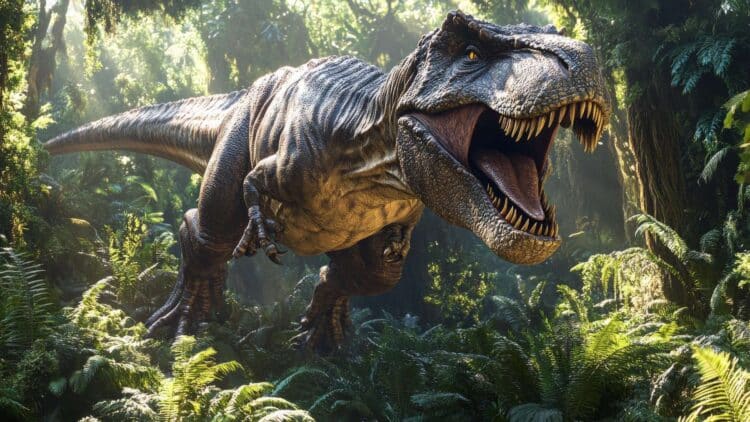
When we think of dinosaurs, the Tyrannosaurus Rex is the undisputed favorite: we imagine it at the top of the food chain, the perfect, solitary predator of the dinosaur era. After all, Jurassic Park has made an impression on us.
For more than half a century, paleontologists have believed that the Late Cretaceous ecosystem was dominated solely by this colossal 12-meter-long animal. However, the recent discovery of a new fossil has rewritten what we know about this era. According to a study recently published in the prestigious journal Nature, Tyrannosaurus Rex actually shared its territory with a much smaller but equally fast and agile relative. This is Nanotyrannus lancensis.
What we knew as a “teenage dinosaur” of the T. Rex family was actually a completely different and adult species. Apparently, Nanotyrannus has spent decades being considered a weak Tyrannosaurus Rex that had not yet reached puberty (isn’t that embarrassing?). How did it manage to coexist alongside the imposing Tyrannosaurus Rex?
Nanotyrannus’ first record
The first time a fossil of this individual was found was more than 80 years ago in the rock formations of Montana, United States. In 1940, a small skull was discovered by chance, baffling scientists of the time. Believe it or not, even in paleontological circles there are heated debates, and this baffling fossil sparked a very long one. Was it a fossil of a separate genus, or just a T. rex in its slender juvenile stage?
For decades, the hypothesis that it was a specimen of an adolescent T. rex was the dominant consensus, so Nanotyrannus (literally called “small tyrant” in Latin) was classified as a growth stage.
However, decades later in 2006, a fossil was found that made paleontologists begin to have their doubts. It was a fossil that showed a Triceratops and a small tyrannosauroid appearing to be fighting.
The evidence that proved them wrong
This unique fossil was the subject of study. Dr. Lindsay Zanno and James Napoli used a combination of comparative anatomy and bone microstructure analysis to solve the mystery. The secret lay inside the bones. All that was needed was a histological analysis. To do this, the researchers examined the growth rings and determined that the specimen was about 20 years old when it died.
This debunked the previous consensus that Nanotyrannus was simply an adolescent T. rex. They could no longer believe that the animal had slowed its growth dramatically. The scientific community had been wrong for decades: it was a small adult, not an adolescent in the midst of a growth spurt that would turn it into a T. rex.
The second set of tests focuses on anatomical features that are fixed and do not change with age. One of the details was their arms, which were proportionally much longer than those of adult or juvenile T. rex. This difference was crucial, as there is no evolutionary precedent in dinosaurs where arms miraculously shorten during growth. Another feature that distinguished the two species was the number of teeth; Nanotyrannus had 14 or 15 teeth on each side of the upper jaw… An adult Tyrannosaurus Rex only has 11-12.
The cranial features were also unique, as they had different patterns of nerves and sinus structures. Its tail was also shorter, not in size, but in the number of vertebrae: 35 vertebrae compared to the 40 of a T. Rex. We can understand why the paleontological community believed that a Nanotyrannus had baby teeth that fell out with age, but extra vertebrae? Something didn’t add up, and it was obvious.
In short, Nanotyrannus turned out to be an adult predator about 6 meters long and weighing an estimated 700-1500 kg, one-tenth of what a T. Rex weighed.