
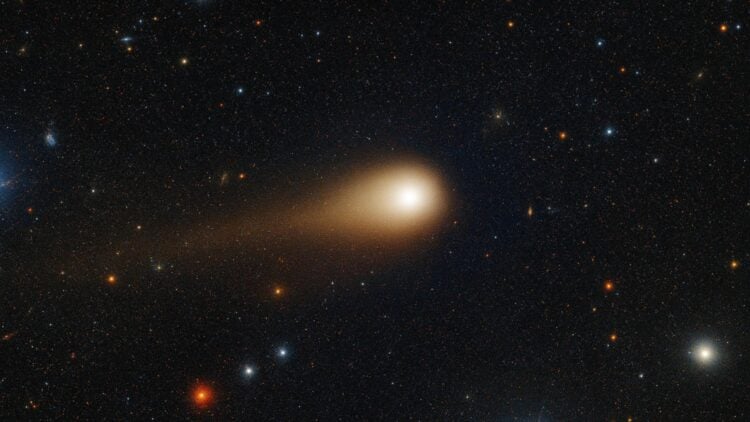
For those who believe in immutable laws, the idea that a star could simply disappear is inconceivable. It is equivalent to a planet vanishing from the solar system overnight. However, it has happened, and astronomers are a. A group of scientists led by Dr. Beatriz Villarroel have confirmed that at least 100 recorded celestial objects have disappeared without a trace. Stars that we could see from Earth… and they have vanished.
This intriguing mystery is worthy of a stellar detective (a kind of Hercule Poirot, but in a space suit), and is currently the subject of study by the VASCO Project (Vanishing and Appearing Sources during a Century of Observations). This event is so baffling that explanations vary widely, from flaws in our understanding of stellar physics to the suspicion of the existence of extraterrestrial civilizations.
Hunting Ghost Stars
The scientists involved in the Project VASCO did not see these stars disappear in real time. Instead, their method of studying these stars consists of comparing old photos with modern photos of the sky. We could call it a kind of stellar archaeology. To study old photographs, they used historical records such as the USNO B1.0 catalog, which are photographic plates taken during the 20th century. Obviously, these plates were less sensitive and capable of capturing as many objects, so they could only detect objects with a brightness magnitude between 20 and 21. On the other hand, they compared this data with much more recent and in-depth digital surveys, such as Pan-STARRS-1, which reaches a magnitude of 23.4.
This made it very easy to study the stars. If an object was clearly visible in the old image, with a much more powerful and sensitive modern telescope, they should have no problem detecting it in the same position. If it does not appear, we have a case of disappearance. After a rigorous process of elimination (a thorough manual review by humans of the original plates), the team found that around 100 solid light sources only appeared in the old records.
The Challenge to Physics
What baffles astronomers is that stars do not simply fade away, so their sudden disappearance is very confusing. When a star’s life ends, a rather violent event occurs. When a massive star dies, it collapses and explodes in a supernova, which can shine brighter than an entire galaxy for weeks or even months. After this, the star disappears, but leaves behind a remnant: a kind of nebula or a compact object such as a neutron star or even a black hole.
Some celestial objects do “disappear” from our view, such as pulsars. However, pulsars only do so because the radiation they emit stops pointing at us, not because the object itself disappears.
In short, if a star is stable (such as those studied by the VASCO project), it should not disappear so easily from the visible spectrum without emitting light.
Possible causes for the disappearance of stars
Scientists have not remained idle in the face of this enigma and have immediately begun to consider various natural explanations.
The most conservative hypothesis is that most of the celestial objects were just quick transients that were captured by pure luck. In other words, rather than being stable stars, they were giant, very short flares from, for example, a red dwarf star, which would have temporarily increased its brightness. Once the flare ended, the star returned to its usual brightness and became invisible to modern telescopes.
Another explanation could be the “Fageda supernova.” The theory predicts that an extremely massive star could exhaust its fuel and collapse directly into a black hole without producing a supernova explosion, which is usually the most common occurrence. If this hypothesis is verified in any of the 100 cases, it would mean the observation of a phenomenon that had been predicted before, but we had never managed to document so obviously: the clean disappearance of a star. This would rewrite the models of stellar death that we have today and would open up a new path in stellar physics.