
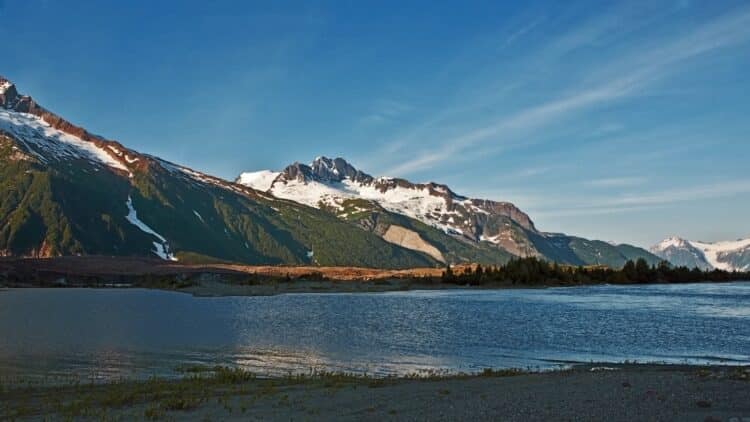
Imagine a geographical discovery in the 21st century. It seemed that we had mapped the entire planet Earth from the North Pole to the South Pole. Sounds like good news, right? Believe it or not, in the summer of 2025, the world gained a new island. However, instead of celebrating with flags and updated maps, the appearance of Prow Knob Island in Alaska is a sign of something bigger on a global scale.
According to NASA, this new emerging island is a clear example of the changes that are taking place with global warming. The separation of this landmass was meticulously documented by the NASA Earth Observatory. The new island is located in Lake Alsek, within Glacier Bay National Park and Preserve in Alaska. Its final separation was completed between mid-July and early August 2025.
From Nunatak to Island
But how did it become an island overnight? To understand how this happened, we first need to learn about its frozen past. The key lies in glaciers. A glacier is not just a simple layer of ice, but a massive, slow-moving river of frozen water. This river acts as an anchor for the surrounding landscape.
Prow Knob, the name of the mountain that is now an island, used to be a nunatak. And what is a nunatak? It is a specific geographical term for a mountain peak that protrudes from a glacial ice field. This peak was surrounded by the immense Alsek Glacier. Alaska’s glaciers have been melting due to the heat of recent decades. Since 1984, the Alsek Glacier has receded more than three miles. This steady retreat has left a void that has been filled by meltwater, dramatically forming what is now known as Lake Alsek.
Prow Knob, a rocky massif, was completely exposed. Now there is an island measuring approximately two square miles (5 km²). Its highest point rises more than 300 m above the surface of the lake, making it the highest lake island in the United States. Prow Knob went from being a peak anchored to a nunatak (surrounded by ice) to being a true island, surrounded entirely by water. Technically speaking, the island did not appear overnight, but rather its surroundings melted and turned from ice to water. (Still, it would be cool to see an island appear overnight, however geologically impossible that may be.)
Prow Knob’s classification from nunatak to island is, unfortunately, one of the many signs of global warming. The Arctic is not only warming, but it is doing so at a faster rate than the rest of the planet for some reason.
Other Geological Transformations Seen from NASA
NASA not only observes the surface of our planet Earth with cameras, but also uses more comprehensive technology. This space technology allows us to monitor a spectrum of ongoing geological changes. For example, we have satellites that provide continuous visual and thermal images of the Earth’s surface.
Then there are InSAR (Interferometric Synthetic Aperture Radar) satellites, which capture movement. These are a kind of space “X-ray” that work by emitting radar pulses and measuring how long they take to bounce back. By comparing two images taken at different times, they can detect movements in the ground of just a few centimeters or even millimeters. Although it may seem strange to us, these measurements are vital for monitoring volcanic deformations. They also help track movements of the Earth’s crust before and after earthquakes. In addition, they are used to detect land subsidence caused by excessive groundwater extraction.
Another crucial tool is the GRACE (Gravity Recovery and Climate Experiment) mission. This mission tracks ice loss in Greenland and Antarctica. Geography, which we always thought of as immovable, is proving to be surprisingly volatile.
So, next time you want to break the ice (or glacier), bring up the topic of Prow Knob Island and how it became an island overnight.