
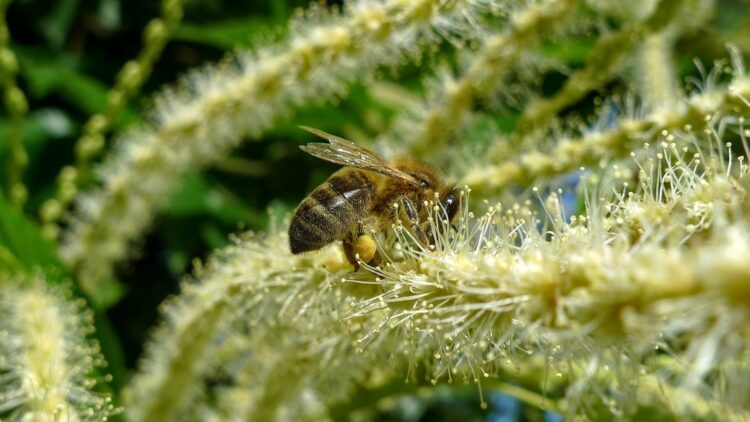
Sometimes, an insect that seems to be a common one can hide an extraordinary story. This was what happened when a scientist observed a bee in a research orchard in Syracuse, New York. At first glance, it seemed like a regular bee, but it was actually a species many experts thought had disappeared in the state for more than a century. So, let’s learn more about this discovery, shall we?
Unexpected come back of a rare insect
Scientists Molly Jacobson, pollinator ecologists, was working at the SUNY College of Environmental Science and Forestry (ESF) when she found two tiny specimens of the chestnut mining bee, also known as Andrena rehni, on blooming American chestnut trees.
This discovery was significant because the species had last been officially documented in southern New York in 1904. After that, there were no confirmed records for more than 100 years. Because of this long absence, the New York Natural Heritage Program labeled the species as “possibly extirpated,” meaning it was possibly gone from the state.
Yet here it was again — and not only in New York, but several hundred miles farther north than anyone expected.
Depending on a tree
The Andrena rehni is a solitary, ground-nesting insect. It doesn’t live in hives and it’s not part of large groups. What’s more, according to the scientist, this species can sting.
What makes this insect so special is its diet: it is a pollen specialist, meaning it relies almost entirely on chestnut and chinquapin flowers for food. Without those specific blooms, the bee has very little to eat and nowhere suitable to raise its young.
The loss of the American chestnut tree
Before the 20th century, the American chestnut tree was one of the most abundant trees in eastern forests. It’s estimated that there were between 3 and 4 billion of these trees, representing about one-quarter of the hardwood trees in the region. The tree was so common that it was sometimes called the “redwood of the East.”
Unfortunately, a fungal disease known as chestnut blight spread rapidly through the forests and, within just a few decades, billions of chestnut trees were killed. As the trees vanished, so did the food sources and habitats for wildlife and insects that depended on them — including the chestnut mining bee. So, with no chestnut trees, it seemed likely that the bee had disappeared as well.
Rediscovery
After decades without confirmed sightings, the species reappeared in 2018 in Maryland, where researchers found it on chinquapin plants. Then, in 2023, Molly Jacobson located a population at Lasdon Park and Arboretum in Westchester County, New York. A specialist from the United States Geological Survey confirmed the identification and that discovery was later described in the journal Northeastern Naturalist as the first contemporary state record of Andrena rehni.
The new discovery in Syracuse pushes the story even further. It marks the first time the bee has been recorded north of the Hudson Valley in New York. This significantly expands the known range of the species and suggests that other overlooked populations may exist in chestnut plantings elsewhere in the state.
Chestnut restoration
The orchard in Syracuse, where the bee was found, is part of ESF’s long-running American Chestnut Research and Restoration Project. Researchers are working to restore the American chestnut using different methods.
Some efforts involve traditional breeding techniques. Others use biotechnology, including the Darling 58 line developed at ESF, which contains a wheat gene that helps chestnut trees tolerate the blight fungus.
According to ESF scientist Andrew Newhouse, the bee provides a living example of how restoring a keystone tree can support specialized wildlife that nearly disappeared when the tree declined.
The environment
In New York, the chestnut mining bee is classified as imperiled and is considered one of the rarest bees in the state. Jacobson has described the bee as an indicator species, its presence suggests that the surrounding environment is still diverse and connected enough to support species that depend on a single resource.
The fact that this rare insect was found in a managed orchard inside a city also suggests that urban and suburban plantings can support surprising biodiversity when the right plants are grown.
So…
The chestnut mining bee may remain invisible to most people. You may never see one. But its quiet reappearance is a hopeful reminder that ecological repair is possible. When the right plants return, the insects and animals connected to them sometimes find their way back too. Isn’t this amazing?