
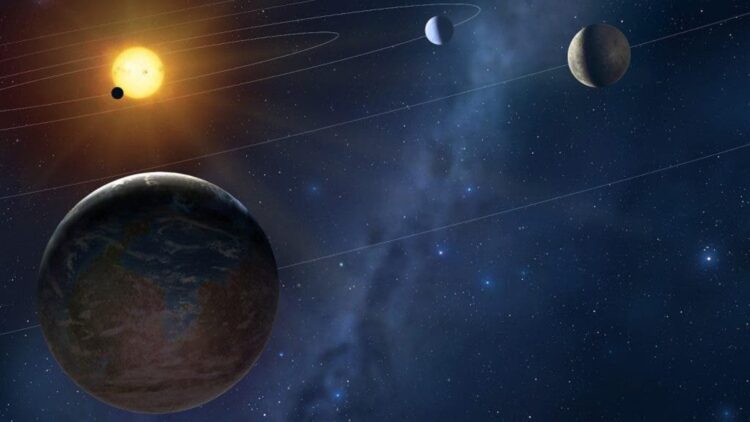
A group of astronomers has found a solar system 116 light-years from Earth that seems to challenge current theories about how planets are formed. This system orbits a star called LHS 1903, and the surprising thing about it is not the fact that it has several planets, but the order in which they orbit.
The discovery was published in Science and has caught many scientists’ attention because it could force astronomers to rethink long-standing theories about how planets are born and arranged around stars. So, let’s find out more about this unusual solar system.
A solar system that breaks the pattern
In our solar system, there is a very clear order: Planets closer to the Sun (Mercury, Venus, Earth, and Mars) are rocky planets, and the ones further are the giant gas planets (Jupiter, Saturn, Uranus, and Neptune) which are mainly formed by gas.
Basically, when a star is born, it’s surrounded by a disk of gas and dust. Near the star the temperature is very high, so only materials like iron and rocks can remain solid. This is why rocky planets are formed there. However, far from the star, the temperature is lower and water and other compounds may become ice. This allows planets to grow faster and accumulate larger amounts of gas becoming giant gas planets.
Challenging planetary formation
The solar system that orbit the LHS 1903 does not follow that traditional order, it has four planets:
- The closest planet is rocky.
- The next two are gas-rich planets.
- The fourth and most distant planet is rocky again.
This outer rocky planet comes after two gas planets, which contradicts the usual formation model. This planet (the LHS 1903 e) is the most surprising one because it has a radius about 1.7 times that of Earth, which is why astronomers describe it as a “super-Earth.”
According to standard theories of solar system formation, a rocky planet should not exist so far from its star and positioned after gas-rich planets. Normally, a planet in that outer position would have gathered large amounts of hydrogen and helium, becoming a gas giant.
After ruling out many possibilities, scientists proposed an explanation called “gas-poor formation,” where the planets formed one after another, starting from the innermost planet and moving outward. By the time the outermost planet formed, there was very little gas and dust left in the disk surrounding the star. Without enough gas available, the final planet remained rocky instead of becoming a gas giant.
Discovery of the solar system
The planetary system was first identified using TESS (Transiting Exoplanet Survey Satellite), a NASA space telescope launched in 2018 to search for exoplanets. After its discovery, the system was studied in more detail using Cheops (Characterising Exoplanet Satellite), launched by the European Space Agency in 2019. Additional observations from telescopes around the world contributed to the international collaboration behind the research.
Some experts have highlighted the importance of this finding. Some of them are:
- Heather Knutson, professor of planetary science at the California Institute of Technology, noted that LHS 1903 e is particularly interesting because it may have a variety of possible atmospheres and could be cool enough for water to condense.
- Sara Seager, professor of planetary science and physics at the Massachusetts Institute of Technology and coauthor of the study, suggested that this discovery could provide early evidence that theories of planet formation around common stars may need revision.
But, at the same time, other astronomers emphasize that planetary formation is complex and still not fully understood. The debate remains open, and future observations will help clarify how this unusual solar system formed.