
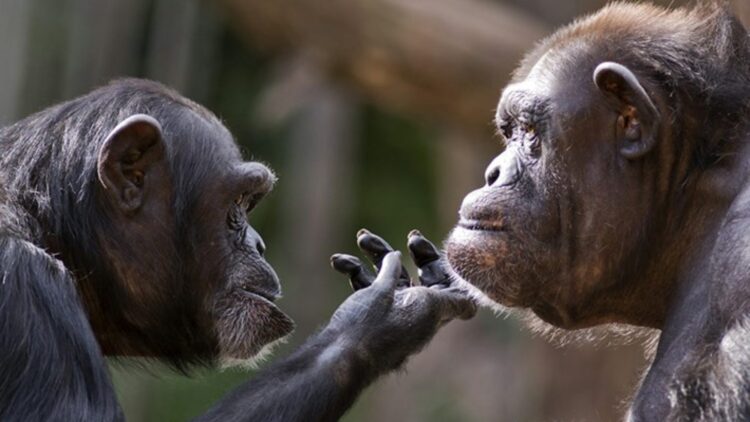
Imagine you are in a forest and you see a chimpanzee get hurt, and the animal decides to carefully clean the wound, chew some leaves, and place them directly on the cut. Now, that same chimpanzee helps another injured chimp in a similar way. Well, this is what scientists have been observing for more than 30 years in chimpanzee communities in Africa.
A recent study, published in Frontiers in Ecology and Evolution, collects decades of observation in two chimpanzee communities called Sonso and Waibira, where chimpanzees treated their own wounds and cared for others, even if they were not close relatives. So, let’s learn more about these animals, shall we?
What researchers observed
For more than 30 years, scientists studied chimpanzees living in the Budongo forest. There, they followed very closely the Sonso and Waibira communities. During this period of time, they collected:
- 34 cases of self-care, where a chimpanzee treated its own injury.
- 7 cases where a chimpanzee treated another individual.
This might seem like a small number, but when it comes to wild animals and uncanny behaviors, this is an important amount of information. And most of the wounds were caused for two reasons:
- Fights within the group.
- Wire snares set by humans to catch antelope, which sometimes accidentally trap chimpanzees.
In the Sonso community, about 40% of known individuals have experienced a snare injury at some point in their lives. This highlights how common and serious this problem is for them.
Chimpanzees and forest first aid
Researchers described how these animals behaved when they were injured in detail. Their actions reminded them of a kind of ‘’first aid’’ in the forest. Some of the techniques they saw were:
- Licking their own wounds.
- Licking their fingers and then pressing them onto a cut.
- Folding leaves carefully and dabbing them onto injuries.
- Chewing pieces of plants and pressing the moist plant pulp directly onto open skin.
More than half of the recorded self-care and prosocial care cases involved the use of plants. Importantly, these animals did not choose plants randomly. For example, they favored specific species such as Acalypha, Pseudospondias microcarpa, and Alchornea floribunda. In African traditional medicine, these plants are used to treat wounds and ulcers. Laboratory tests have shown that they have antibacterial, antifungal, and anti-inflammatory properties.
In one particularly detailed observation, an injured chimp chewed the bark of Argomuellera macrophylla, dabbed its knee with attached leaves, and then pressed the chewed material directly into the wound. Later, another chimpanzee appeared to use the same plant while treating her mother. This repeated pattern suggests that the behavior may be learned.
Scientists do not claim that chimpanzees understand the chemical properties of these plants. Instead, they suggest that chimpanzees likely learn through experience and social observation which plants seem to work, without knowing why they work at a molecular level.
Hygiene and daily care
The study also collected hygiene behaviors that are surprising because of how similar they are to those seen in humans. Some chimpanzees used leaves to clean their genitals after mating and others used them to clean themselves after defecation. They even observed a young chimpanzee removing a snare that was wrapped around its own limb.
These behaviors show that attention to body care in chimpanzees is not limited to serious injuries. Cleanliness and self-maintenance are also part of their everyday lives.
Caring for others
One of the most striking aspects about the study involves chimpanzees helping others:
- Licking another individual’s wounds.
- Pressing their own fingers into cuts on a companion.
- Applying chewed leaves to injuries on non-relatives.
- Attempting to free others from wire snares, even though the metal could tighten or snap.
These actions were not quick grooming sessions, they appeared focused and directed at the injured area. The animals seemed patient and careful in their movements.
Some experts consider these behaviors could be related to the roots of empathy and caregiving in our evolutionary family tree. However, researchers also say that these prosocial acts are rare and may depend on strong social bonds or high levels of trust within the group.
So…
For humans, these findings offer insight into how healthcare may have begun long before hospitals, pharmacies, or modern medicine.
For chimpanzees, if human-set snares continue to injure animals, and if important medicinal plants disappear due to logging or climate stress, the community risks losing both individuals and learned knowledge.