
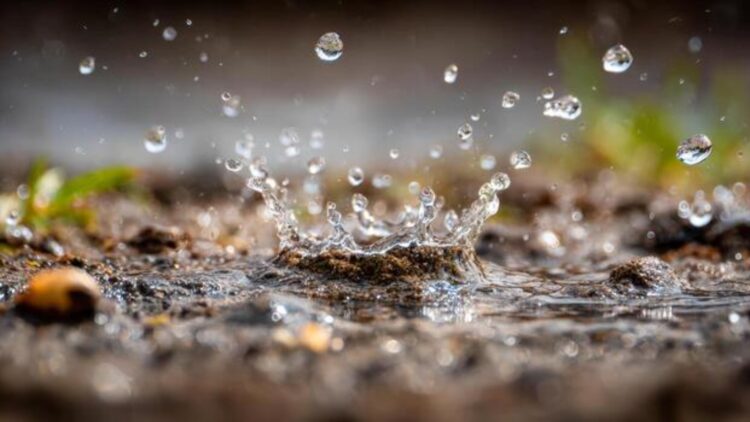
Can you imagine a single raindrop moving a lot of soil? The common idea is that it takes a lot of water to move a lot to earth, but a recent study shows that a single raindrop can move up to ten times more soil than scientists previously believed.
The research was published in the Proceedings of the National Academy of Sciences, one of the most respected scientific journals in the world. So, let’s find out more about this study, shall we?
A single raindrop can do more than just splash
For many years, scientists have explained that soil erosion was caused by rain in a simple way: a raindrop falls and impacts against the soil making small grains of soil that go in different directions. This process is known as splash erosion.
According to traditional models, this is where the most part of the effect of a single raindrop. It was thought that after the initial impact, the drop would simply break apart or be absorbed into the soil. But this new study shows that, in certain conditions, this is not what happens all the time.
When the soil is dry and located on a slope, the drops tend to survive the impact because they roll down the slope. And that’s when an unexpected process starts.
The experiment
To study this phenomenon, researchers designed an experiment in controlled conditions. They built an inclined channel 1.2 meters long and filled it with silica sand. The slope was set at 30 degrees, just below the angle at which the sand would start sliding on its own.
Then, the drops used were a mixture of water and glycerol, which allowed them to modify the viscosity of the liquid, which is a measure of how resistant it is to flowing. Viscosity became a key factor.
When the drop impacts against the sand, it sometimes bounced slightly and then began to roll downhill. As it rolled, it picked up grains of sand, and the drop gradually grew larger and transformed into a small wet sand ball. That’s why researchers called these structures ‘’sandballs.’’
The process is not random. First, the drop must resist the impact. Then, it must start to roll. Finally, the shape the drop adopted depended on the balance between the liquid’s viscosity and the centrifugal force generated as it spun downhill.
Donut effect
One of the most striking aspects about the study was that these sandballs adopted two very clear stable shapes:
- The first one was similar to a peanut. This shape appeared when the liquid was more viscous. So, the sand grains were trapped on the outer surface of the drops, creating an elongated structure with a liquid core.
- The second shape was a great surprise: a structure similar to a donut. When the viscosity was lower, the grains moved toward the center of the rolling drop. As the structure spun, centrifugal force pushed the wet sand outward, creating a hollow center. The result was a toroidal shape, similar to a tiny ring or wheel. In this donut configuration, the grains became so tightly packed that the structure reached a “jammed” state, behaving almost like a solid object. This stability allowed it to roll efficiently downhill, continuously collecting more sand as it moved.
Ten times more soil displaced
When measuring the amount of sediment transported by these sandballs, researchers discovered that a single raindrop could move up to ten more materials than the one calculated considering just the initial splash. In some cases, the transported mass was two orders of magnitude greater than what traditional models suggested. This means that current erosion models may significantly underestimate soil loss, especially on dry, sloped surfaces such as agricultural fields.
Until now, calculations focused mainly on the moment of impact. But they ignored what happened afterward—when a drop rolled downhill and turned into a tiny, sediment-carrying wheel.
So…
Understanding this process is essential for improving soil erosion models, refining predictions about agricultural land loss, and gaining a clearer picture of how landscapes evolve over time.
A single drop may seem small. But multiplied by millions during a rainstorm, this hidden mechanism can play a significant role in shaping hillsides, farmland, and entire landscapes.