
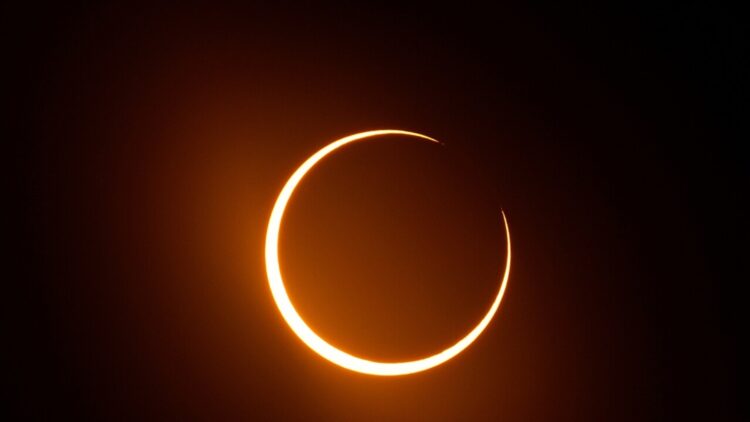
The first solar eclipse of the year will happen over Antarctica, where very few people live but there are many penguins. This astronomical phenomenon will be an annular solar eclipse, also known as ‘’ring of fire.’’ According to astronomer Joe Llama, from the Lowell Observatory, people at the right place to see it (including penguins) will witness a great spectacle. So, let’s talk a bit more about this phenomenon.
What’s a solar eclipse?
This happens when the Sun, the Moon, and Earth are perfectly aligned. At this moment, the Moon is between the Sun and the Earth and it blocks part of the sunlight.
There’s a special coincidence in our solar system: the Sun is about 400 times bigger than the Moon, but is also around 400 times further from Earth. Due to this proportion, from our planet both seem to have almost the same size in the sky. Thanks to this, solar eclipses are possible.
Ring of fire
This event will be an annular eclipse, where the Moon doesn’t completely cover the Sun. This happens because the Moon is not always at the same distance from Earth. Sometimes this is closer and other times it’s further, and when the Moon is at the farthest point in its orbit around Earth, that point is called apogee.
During this astronomical phenomenon, the Moon will be near apogee. It will be about 251,000 miles away from Earth. On average, the Moon is about 238,900 miles away, according to NASA.
Because the Moon will be farther away than usual, it will appear slightly smaller in the sky. That means it will not completely cover the Sun, but it will leave a thin, bright ring of sunlight visible around the edges.
Who could see the eclipse?
Antarctica will be the place where the eclipse will be seen very clearly. There, scientists working at research stations and colonies of penguins will be able to see it. This is why Joe Llama joked about penguins going to have a great show.
Some other parts of the world may see a partial eclipse if the sky is clear. These areas include southern Chile and Argentina, as well as parts of southeastern Africa, including Madagascar and South Africa. In these places, people will not see the full “ring of fire,” but they may see part of the Sun covered by the Moon.
According to NASA, solar eclipses happen somewhere on Earth two to five times per year. However, they are usually only visible along narrow paths.
Careful with solar eclipses
Experts strongly warn that you must never look directly at a solar eclipse without proper protection. You need special eclipse glasses that meet the ISO 12312-2 safety standard. If you look directly at the Sun without proper protection, you can seriously damage your eyesight.
So, anyone planning to observe an eclipse, even a partial one, must use the correct safety equipment.
The astronomer behind this idea
Joe Llama, an astronomer at the Lowell Observatory, explained how the Moon’s distance affects what we see in the sky. Joe Llama made the “ring of fire” eclipse easier to understand for everyone.
So…
Moments like this invite you to look up, stay curious, and appreciate the incredible mechanics of space happening above you — whether you are in Antarctica, South America, Africa, or simply learning about it from afar.
Have you ever witnessed an astronomical event like this? If you haven’t, do you want to see one?