
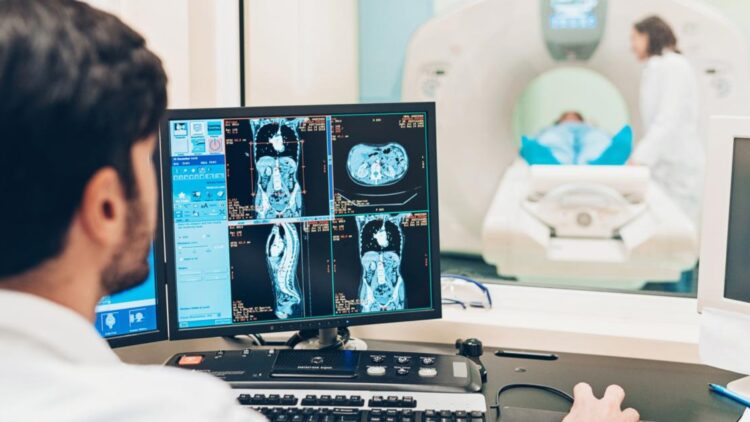
For years, many people thought artificial intelligence was going to eliminate certain jobs, especially those using data and images, like radiology. This idea started because artificial intelligence is very good at analyzing images and identifying patterns, so some experts predicted that radiologists might eventually be replaced by machines.
However, this job still exists, and it’s even growing. Basically, radiology has become a clear example of how artificial intelligence can support a job instead or eliminate it. Let’s find out more about this situation.
Artificial intelligence and radiology
Radiology has recently been mentioned by technology executives at the World Economic Forum in Davos and in a White House document about artificial intelligence and the economy. This shows that this is a medical, political, and economic issue.
What’s more, the Goldman Sachs bank estimates that advances related to artificial intelligence could replace between 6% and 7% of the U.S. workforce. However, it’s also expected that technology creates new jobs.
Radiology became a very important issue in this debate since most people think that artificial intelligence is very good at analyzing images and detecting patterns, therefore, radiologists would lose their jobs. In 2016, computer scientist Geoffrey Hinton, often called one of the pioneers of artificial intelligence and a Nobel Prize winner, said that people should stop training to become radiologists because deep learning systems would soon do the job better. His comments created concern in the medical field.
How artificial intelligence is changing this job
Artificial intelligence is good and fast at processing huge amounts of data. In radiology, almost every medical image is digitalized, which means that X-ray, CT scan, and MRI is stored digitally, making it easier for artificial intelligence systems to analyze them.
Today, artificial intelligence helps radiologists in several ways:
- Identifying which scans need immediate attention.
- Improving image quality.
- Assisting with summaries of medical reports.
Now, let’s see what experts have said about artificial intelligence:
- Dr. Po-Hao Chen, diagnostic radiologist at Cleveland Clinic, explained that radiology has large amounts of data available for research and artificial intelligence training. This makes it an ideal area for technological assistance.
- Dr. Shadpour Demehri of Johns Hopkins Medicine said that artificial intelligence does not replace doctors. Instead, it makes their work more efficient and meaningful.
- René Vidal, a professor at Penn Engineering at the University of Pennsylvania, explained that artificial intelligence can also help produce high-quality MRI images using fewer measurements. This speeds up the process and allows more patients to be seen in the same amount of time.
Despite these advances, human doctors are still needed to make final diagnoses, examine patients, and write official medical reports.
Approval and job growth
Medical artificial intelligence tools must be approved by the Food and Drug Administration (FDA) before they can be used in healthcare. This approval process can take around eight years, including development and clinical testing.
Out of the 1,357 medical tools with artificial intelligence that have currently been approved by the FDA, 1,401 belong to radiology. This shows that technology is being actively adopted in this field.
At the same time, data prove that radiology jobs are growing. The Bureau of Labor Statistics projects that radiology jobs will grow by 5% between 2024 and 2034, which is higher than the overall average job growth rate of 3% for all occupations.
Risks and limits of artificial intelligence
Even though artificial intelligence provides some benefits, there are also some risks. For example, a MIT study in 2022 showed that artificial intelligence can accurately predict a person’s race from an X-ray image. This raises concerns about possible bias in medical decisions.
Dr. Chen also warned about the risk of overreliance on artificial intelligence. He emphasized that much of the system’s success comes from the fact that automated results are reviewed by human experts. So, the collaboration between machine and specialist is what produces real improvements.
To sum up
As you think about the future of work, radiology serves as a reminder that change does not always mean loss. In many cases, it means adaptation. The partnership between professionals and technology may shape tomorrow’s jobs — not by removing them, but by transforming how they are done.