
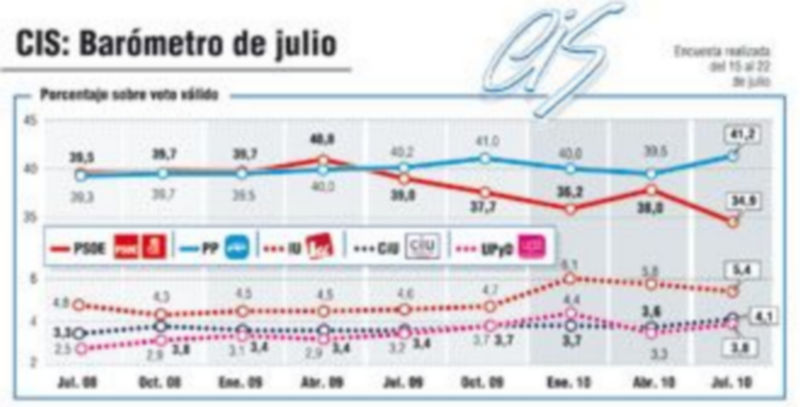
Si, tal y como reclama la oposición, se celebrasen ahora mismo elecciones generales, el PP arrasaría con un 41,2 por ciento del voto estimado, lo que le otorgaría una ventaja del 6,3 por ciento sobre el PSOE, la mayor jamás registrada desde que gobierna José Luis Rodríguez Zapatero. Según pone de manifiesto el último Barómetro del Centro de Investigaciones Sociológicas (CIS), tradicionalmente proclive al partido en el poder, el plan de ajuste de los socialistas y el debate sobre el estado de la Nación, han dejado al inquilino de Moncloa a los pies de los caballos, con una intención de voto del 34,9 por ciento, la más baja desde octubre de 2003. Por si tal dato no fuera lo bastante demoledor, dicho porcentaje es el más raquítico que logra un partido en el poder en los últimos 15 años.
Como parece lógico, semejante descalabro beneficia sobremanera a la formación de Mariano Rajoy, que repunta un 1,7 por ciento con respecto al Barómetro anterior y abre brecha sobre un socialismo que pierde 3,1 puntos.
Pese a lo que podría pensar algún romántico despistado, la debacle del PSOE no favorece a la que se proclama verdadera izquierda, puesto que IU ve disminuidas sus expectativas electorales en cuatro décimas y se coloca en un 5,4 por ciento de voto estimado.
Por si las desgracias de Zapatero no fueran bastantes, CiU se consolida como tercera fuerza política, con un 4,1 por ciento de intención de voto, cinco décimas más que en abril. Tal circunstancia, unida a la concentración de los apoyos de la formación catalana, augura un negro porvenir para Montilla y su extemporánea estrategia neo nacionalista.
La quinta fuerza política igue siendo UPyD, que también mejora cinco décimas hasta lograr el 3,8 por ciento de los sufragios.
Mientras tanto, ERC cosecharía el 1,4 por ciento de las papeletas, y el PNV el 1,3 por ciento. Todavía más marginales, BNG y CC conseguirían el 1,1 y el 0,4 por ciento, respectivamente, porcentajes tan pírricos como relevantes podrían resultar en función de la distribución de los escaños habida cuenta de lo peculiar del actual sistema electoral no del todo proporcional.
Por lo que respecta al voto directo bruto, es decir, sin tabular por los técnicos del CIS, se invierte el resultado del sondeo anterior y el PP también resulta claramente ganador, con el 24,8 por ciento de respaldo, justo cuatro puntos más que el PSOE, que se queda con el 20,8 por ciento.
Ni el uno, ni el otro
Como es habitual en estas encuestas, el CIS también ha preguntado por la confianza que despiertan Zapatero y Rajoy entre los ciudadanos. Ambos líderes, como también ocurre desde hace ya algún tiempo, son ampliamente denostados por la sociedad, que considera cada vez más a los políticos como un verdadero enemigo.
Es así hasta el punto de que Zapatero despierta poca o ninguna confianza en el 78,9 por ciento de los ciudadanos, una cifra que se antoja completamente kafkiana y que supera en casi cuatro puntos a la registrada hace tres meses.
Poco más cabe añadir por lo que respecta al 84,6 por ciento que critica a Rajoy, un 2,6 por ciento más que en la última encuesta.
De manera plenamente consecuente, la gestión del Gobierno es considerada mala o muy mala por el 55,5 por ciento de los ciudadanos, mientras que el 7,8 la enjuicia como buena o muy buena.
Tampoco sale bien parada la oposición de los conservadores, pues un 60,9 por ciento de los encuestados opina que su actuación es mala o muy mala, frente al 8,3 que la describe en positivo.
Dentro del fuerte rechazo general que despierta la clase política, cada día más asociada a la ineficacia y la corrupción, el jefe de Interior, Alfredo Pérez Rubalcaba, es el ministro mejor valorado, con una casi vergonzosa nota de 4,47 sobre diez. Tal suspenso, que comparten todos y cada uno de los socialistas que dirigen el país, queda algo disimulado en el caso de nueve responsables ministeriales, cuya consideración es mejor que la de Zapatero. Entre ellos están Chacón (4,23); Gabilondo (4,0), y la vicepresidenta De la Vega (3,97). En cualquier caso, todos ellos empeoran la puntuación que lograron hace tres meses.
La triste excepción es la jefa de Cultura, Ángeles González-Sinde, que, aunque se mantiene como la peor valorada, con un 2,98, mejora ligeramente su lamentable nota.
En cuanto a su percepción de la situación económica, los ciudadanos se muestran algo más optimistas que el trimestre anterior y sube del 16 al 22 por ciento quienes confían en que mejorará dentro de un año. Por supuesto, continúa siendo muy mayoritario (74,4 por ciento) el porcentaje de quienes creen que la coyuntura actual es mala o muy mala.
El paro vuelve a encabezar la lista de preocupaciones para el 78 por ciento de los encuestados, por delante de los problemas de índole económica, citados por el 51,3, y la clase política, que, cual monstruo maligno, inquieta al 21,7 por ciento de los españoles.
