
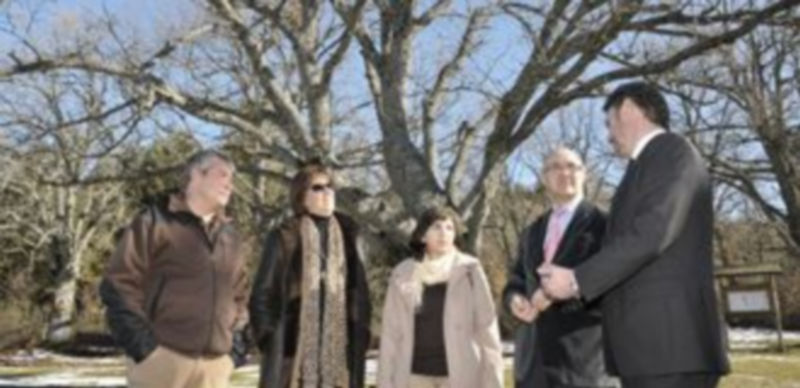
El Centro Nacional de Educación Ambiental (Ceneam) propone un amplio programa de actividades para este año, basado en la educación, formación y divulgación. Así lo explicó ayer el delegado del Gobierno en Castilla y León, Ramiro Ruiz Medrano, que realizó una visita institucional al centro, acompañado del alcalde del Real Sitio, José Luis Vázquez; la subelegada del Gobierno, Pilar Sanz; el director del Ceneam, Juan Carlos Dueñas; y el director del Centro Montes y Aserradero de Valsaín, Javier Donés.
De cara a este año 2013, el Centro de Educación Ambiental ha diseñado un plan de actividades articulado en cinco epígafres. Por un lado, se encuentra la elaboración, desarrollo y evaluación de programas y materiales de sensibilización, divulgación, interpretación, educación y participación ciudadana sobre medio ambiente. Incluye actividades con escolares, con familias (Hogares Verdes), excursiones didácticas y exposiciones. Por otro, ofrece servicios de información y documentación especializados en divulgación, comunicación y educación ambiental sobre energía, cambio climático, residuos, contaminación, recursos naturales, fauna, etc.
El Ceneam también albergará reuniones, seminarios y otros foros de reflexión, debate y coordinación sobre medio ambiente y educación ambiental. Asimismo, llevará a cabo acciones de formación ambiental dirigidas a diferentes sectores de la población, como el “Aula verano-abierta”, “Aula virtual”, “En-torno a los parques nacionales” y “Desarrollando la red de parques nacionales”.
La última línea de actuación es la cooperación con entidades públicas y privadas, tanto en el ámbito nacional como internacional, para la promoción de la educación ambiental.
Durante el año pasado, el Ceneam recibió cerca de 10.000 visitas entre los diferentes programas educativos y visitas a las exposiciones temporales e itinerantes. Además, entre actividades propias y de otras instituciones, en 2012 se celebraron un total de 102 cursos, con la participación de 3.000 alumnos, de los que la mitad pernoctó en las cabañas.
En material de comunicación digital, la página web del Centro recibió 600.000 visitas el pasado año, mientras que más de 6.000 personas están suscritas a su boletín electrónico.
El delegado del Gobierno en Castilla y León, que está visitando los más de treinta centros nacionales de la Comunidad, destacó el importante patrimonio medioambiental de la región, y abogó por conservarlo. En este sentido, Ruiz Medrano aseguró que el Ceneam “contribuye a incrementar la responsabilidad de los ciudadanos con educación, formación y divulgacion”. El delegado insistió en la importancia del Ceneam, un centro de referencia en educación ambiental desde hace veinticinco años.
La Reserva de la Biosfera será una realidad en mayo.- Los municipios del Real Sitio de San Ildefonso y El Espinar recibirán en el mes de mayo la declaración de Reserva de la Biosfera por parte de la Unesco, según anunció ayer el alcalde granjeño, José Luis Vázquez. Éste explicó que los consistorios han recabado las últimas informaciones de cara a la próxima reunión del Comité Científico, que previsiblemente tendrá lugar en el mes de marzo. “La recepción podría efectuarse en mayo, aunque será en octubre cuando se celebre el acto institucional”, señaló Vázquez.
La iniciativa, impulsada desde el Real Sitio, persigue establecer como propuesta de territorio de la Reserva de la Biosfera, la Sierra de Guadarrama. La propuesta fue apoyada en octubre de 2011 por el Comité Español del programa MaB (Hombre y Biosfera), en el que están representados el Gobierno de España, todas las comunidades autónomas y diversas universidades nacionales.
La Sierra de Guadarrama será la primera Reserva de la Biosfera de la provincia de Segovia y la novena de Castilla y León.
