
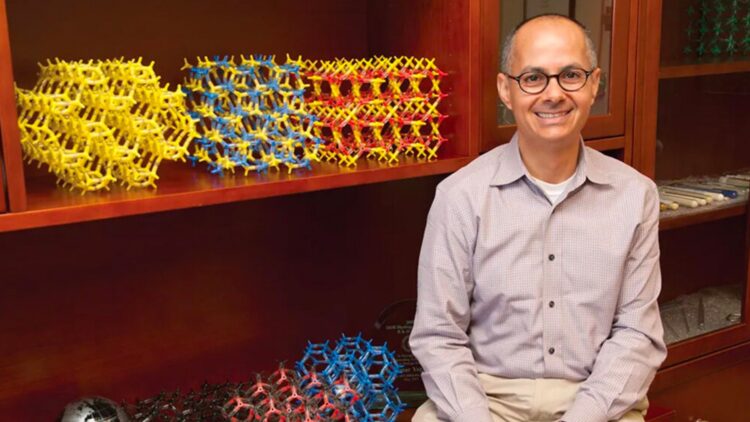
Throughout history, civilizations have been remembered by the materials that marked their development and Omar Yaghi, chemist from the University of California in Berkley and shared winner of the 2025 Nobel Prize in Chemistry, believes that new types of materials could define the future. Taghi helped develop these materials in the 90s and he says they can change the way we solve important issues for society. So, let’s learn more about this important development.
MOFs and COFs
These are crystalline materials that stand out because they are extremely porous. In 1999, Yaghi’s team created a zinc-based material called MOF-5, which contained so many tiny pores that just a few grams had an internal surface area comparable to a football field. In simple terms, the inside of the material was much larger than the outside. Because of these many internal spaces, other molecules can be absorbed into the material, which allows MOFs and COFs to capture substances such as water or carbon dioxide.
When Yaghi first began working on these materials, the goal was not necessarily to solve social problems but to overcome a scientific challenge: creating ordered, crystal-like structures by carefully assembling molecules like building blocks.
It was difficult to design them
Designing these materials in a controlled and predictable way was almost impossible because when we mix chemical substances they tend to form disordered structures that are hard to analyze.
Yaghi compared the challenge to asking a group of children to form a perfect circle by holding hands because it requires coordination and effort, and the circle can easily fall apart. The aim was to create ordered materials quickly, something that natural processes, such as the formation of diamonds, may take billions of years to accomplish.
Eventually, Yaghi’s team succeeded by identifying a solvent that helped control disorder during the synthesis process, allowing them to produce stable MOFs that researchers around the world later used.
Technologies and applications based on Yaghi’s materials
With the passage of time, scientists discovered that the great porosity of these materials made them very useful for several things, like:
- Capturing carbon dioxide from the air: In 2024, researchers reported a material called COF-999, which successfully captured and released carbon dioxide more than 100 times in tests conducted in Berkeley. Yaghi’s company, Atoco, founded in 2020, aims to use reticular materials like COF-999 to build carbon-capture modules for industrial facilities and residential buildings.
- Harvesting water from the air: The team developed materials capable of collecting thousands of liters of water per day, even in areas with humidity levels below 20 percent, such as desert regions in Nevada. Yaghi believes that water-harvesting technology could become common within about ten years.
The design process for these materials can be described simply: scientists select the backbone structure, determine the size of the pores, and then tailor the material to capture specific molecules. Some devices can operate efficiently by using sunlight to release captured water or industrial waste heat to release carbon dioxide.
Current challenges and artificial intelligence
Despite these positive advances, there are still some challenges. Some materials, like COFs, can’t be produced in large quantities yet. Also, it’s necessary to improve chemical stability and control with precision when releasing the absorbed molecules.
To accelerate development, researchers are now using artificial intelligence to optimize designs. While making a MOF or COF is generally straightforward, creating one with highly optimized properties can take up to a year. According to Yaghi, using large language models and other AI tools has already doubled the speed at which some new MOFs are developed.
So…
Instead of only discovering materials, scientists can now design them with a clear purpose. According to Yaghi, this new way of creating materials could influence future technology and play an important role in the next era of science and industry.