
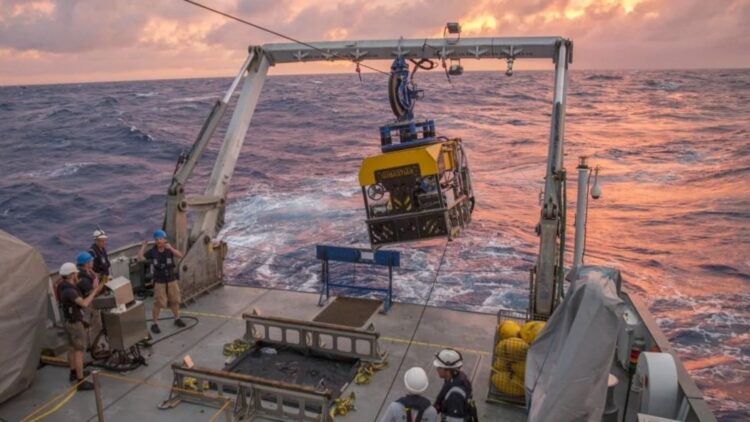
A team of marine biologists from the Schmidt Ocean Institute carried out a scientific expedition in the South Atlantic Ocean, near Argentina aboard the research vessel Falkor (too). The main goal of this research was to study deep areas of the ocean called ‘’cold seeps’’ because these places of the seabed release gases and chemical substances from the ground and create special ecosystems where life can grow in unusual ways.
During the mission, scientists made unexpected discoveries. Although they only found one active area (the ‘’cold seeps’’), they were surprised to see a huge amount of marine life in the entire region. The team identified about 28 possible new species, so let’s find out more about this mission in more detail, shall we?
What they were looking for and what they found
Researchers were very interested in studying the ‘’cold seeps’’ because these places help support life in the seabed. Chemical substances like methane come out of the ocean floor and feed microorganisms, and these small organisms are the food for other bigger animals, like tube worms, clams, and mussels. Thanks to this process, very special marine ecosystems are created.
The expedition was led by chief scientist María Emilia Bravo, who explained that the team didn’t expect to find such a high level of biodiversity in the Argentinian deep sea. Also, other scientists from the Instituto Argentino de Oceanografía took part in the expedition, like marine biologist Melisa Fernández Severini and Jyotika Virmani, executive director of the Schmidt Ocean Institute, who highlighted how important these discoveries are for understanding life in the ocean.
Discoveries in the South Atlantic deep ocean
One of the most important results of the expedition was the identification of 28 possible new species, among them they found sea snails, sea urchins, anemones, and worms. Many of these animals were living inside the largest known deep-sea coral reef of the species Bathelia candida, a massive coral colony that is almost the size of Vatican City.
The team also documented an extremely rare phantom jellyfish called Stygiomedusa gigantea, which is known to grow as long as a school bus. Another major discovery was Argentina’s first deep-sea “whale fall.” A whale fall happens when a whale dies and its body sinks to the ocean floor. At a depth of about 2.4 miles below the surface, the whale’s bones are now serving as a temporary home and food source for sharks, crabs, and other marine animals.
According to María Emilia Bravo, observing so many different species and ecosystem functions together was like opening a window into the country’s biodiversity and realizing that many more discoveries are still waiting to be made.
Marine biodiversity in the South Atlantic
The expedition showed that the deep ocean may be full of life, probably as much as or even more than the land. Jyotika Virmani explained that the ocean has 98% of the living space on Earth, which helps explain why scientists continue to discover new species and ecosystems there.
The images and videos published by Schmidt Ocean Institute show the great variety of marine biodiversity in the South Atlantic.
So…
These discoveries invite you to think about how much of the South Atlantic — and the ocean as a whole — is still waiting to be explored. Each expedition reveals new knowledge and reminds us that the deep ocean holds countless secrets that scientists are only just beginning to uncover.
It’s incredible how little we know about what’s hidden deep in the ocean, it’s almost like the universe. The more researchers explore, the more new things we know. So, we’ll see if their next adventure will lead to new discoveries.