
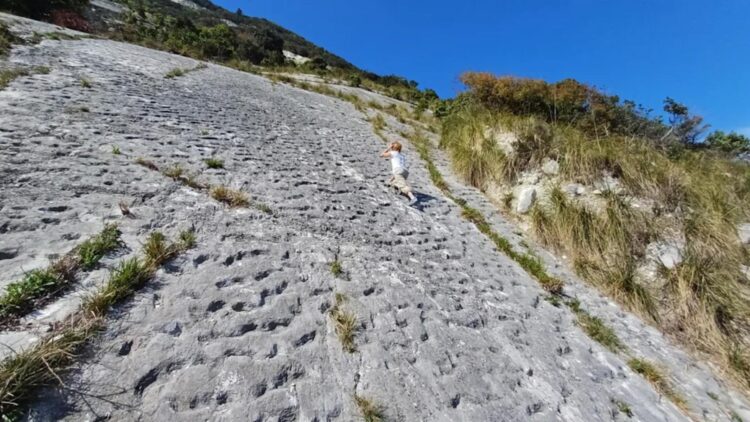
Today we are going to talk about an incredible discovery made by some climbers in Italy. The discovery has to do with sea turtles. Climbers and sea turtles? Yes, they found them in the Cònero Mountain, which is a mountain overlooking the Adriatic Sea.
Once scientists took over, they published the results in the journal Cretaceous Research, with additional information shared through Live Science. The study suggests that the grooves may have been made by ancient marine reptiles—possibly sea turtles—that were moving quickly across the seafloor, potentially while escaping an earthquake. So, let’s find out more about this discovery, shall we?
How the discovery was made
A group of climbers were climbing in Italy the Cònero Mountain, an area known for geological formations that preserve millions of years of deep-sea history, and saw some strange grooves carved into the rock, which looked similar to other fossil traces that had been discovered earlier in the same regional park. So, the climbers decided to contact geologist Paolo Sandroni, who then contacted Alessandro Montanari, director of the Coldig ioco Geological Observatory (OGC).
Sandroni and another team member returned to the site to collect rock samples and use a drone to document the location and the markings. Scientists found hundreds of tracks on a layer of Scaglia Rossa limestone, a formation that has been studied for decades because it contains ancient deep-sea sediments.
What scientists believe about the marks
Researchers think these marks were made by large marine vertebrates that lived during the Late Cretaceous Period, around 79 million years ago. The only animals strong enough to leave these marks were marine reptiles, like sea turtles, plesiosaurios, or mosasaurios.
However, scientists consider that sea turtles could be the most reasonable explanation because some current sea turtle species gather together for activities such as feeding or nesting. So, if ancient species behaved in a similar way, it’s probable that many individuals were present in the same area when the tracks were made.
It seems that these animals were pushing against the seafloor with their limbs as they moved forward and scientists believe this happened because of an earthquake that scared them, making most of them moving very fast and at the same time.
Geology
Currently, Cònero Mountain is a mountain, but millions of years ago it was part of the deep seabed. Over time, tectonic forces folded and lifted these underwater sediments above sea level.
Normally, marks on the deep seabed disappear very fast due to currents and activity of small organisms, like worms and clams that disturb the sediment. However, in this case, the avalanche covered the marks almost immediately, which allowed them to preserve them for millions of years.
Also, thin slices of the rock revealed microfossils from organisms that lived along the seafloor, confirming that the environment was a deep underwater setting hundreds of meters below the surface.
Are they really sea turtles?
Not every expert is completely sure about which animal made these marks. For example, Michael Benton, a professor of vertebrate palaeontology at the University of Bristol in the United Kingdom who was not involved in the research, said the geological evidence for an underwater avalanche is clear. However, he questioned whether sea turtles were responsible for the marks.
Benton pointed out that the marks seem to show a movement in which the two front limbs were pushing into the sediment at the same time, which is something unusual in many vertebrates. What’s more, he explained that modern sea turtles tend to swim using a motion similar to underwater flying, which may not match the movement suggested by the tracks. He also questioned why the animals didn’t just swim far from the seabed.
Despite all these doubts, Montanari highlighted that the geological evidence clearly shows there was an underwater avalanche caused by an earthquake.
To sum up
The team hopes that further studies help identify which species left the marks more precisely. But, isn’t it incredible how anybody can find a scientific discovery? Who would have told these climbers they would find these marks?