
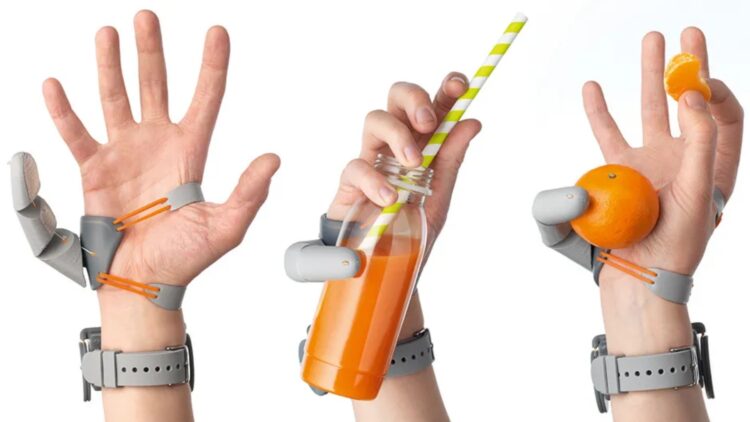
Can you imagine having an extra thumb on your hand that you can control in just one minute? Researchers from Cambridge University have created exactly that: a robotic device called Third Thumb. In the study, almost every person who tried it started picking up things with their extra thumb in about 60 seconds.
The Third Thumb is part of a growing field called wearable motor augmentation, which aims to give humans new abilities using technology. Unlike most lab experiments that only work for a small group of “average” users, this study tested the device on 596 people of all ages at the Royal Society Summer Science Exhibition in London, from toddlers to people in their nineties. So, let’s learn more about this robotic device, shall we?
The Third Thumb
This is a small robotic thumb that’s placed next to the natural thumb, on the right hand. It’s 3D-printed and it comes in two sizes, with flexible straps so it fits almost any hand. The most striking thing is how it’s controlled because it uses pressure sensors under the big toes and this is how it works:
- Pressing one toe moves the thumb across your palm.
- Pressing the other moves it toward your fingers.
- The harder you press, the further the thumb moves.
This system allows the brain and body to control the extra thumb almost immediately. During the study, participants had up to one minute to learn how to use it and then do some tasks such as:
- Using the Third Thumb along with the natural fingers to move foam shapes requiring more precision.
- Picking up small pieces and leaving them in a basket using just the robotic thumb.
Surprisingly, 98% of participants succeeded in handling objects during their very first minute, showing that even complex tasks can be achieved quickly with the right design.
Who learns the fastest?
Researchers analyzed how age, gender, and experience affect the Third Thumb learning. However, many common assumptions didn’t matter:
- Men and women performed equally well.
- Left-handed and right-handed users adapted similarly, even though the thumb was always mounted on the right hand.
- People with “handy” hobbies or musical skills did not have a major advantage in this short test.
Age did matter because young adults were the fastest to adapt. Then, older adults, even in their sixties, also had a very good performance, though the very oldest participants showed a small decline in speed and dexterity. Children under 11 struggled more, suggesting that factors like motor control, attention, or instruction clarity could influence early performance.
The inclusive design of this robotic device shows that most people, regardless of age or skill, can quickly learn to use an extra finger. Only a few participants could not use it due to fit or insufficient pressure on the toe sensors.
Why an inclusive design matters
This project is part of a wider conversation about technological accessibility. Many tools and devices are designed only for ‘’average’’ users, which can cause issues, like:
- Power tools or car safety equipment often favor right-handed men, causing disadvantages for women or left-handed users.
- Speech recognition systems sometimes fail for people with darker skin or strong accents.
However, the Third Thumb avoids these pitfalls by being adjustable and usable by almost anyone. Beyond fun and experimentation, wearable motor augmentation like this device has practical applications:
- People with disabilities could gain new ways to interact with objects and their environment.
- Workers could use extra robotic fingers to hold tools or materials, reducing strain and preventing injuries.
- Lab technicians could perform delicate tasks without awkward hand positions, making work safer and more efficient.
So…
By understanding how this innovation works and why inclusive design matters, you can begin to imagine a future where using wearable technology on your own body feels completely normal. Today it may be an extra thumb, but tomorrow it could be a new way for you to interact with the world around you.