
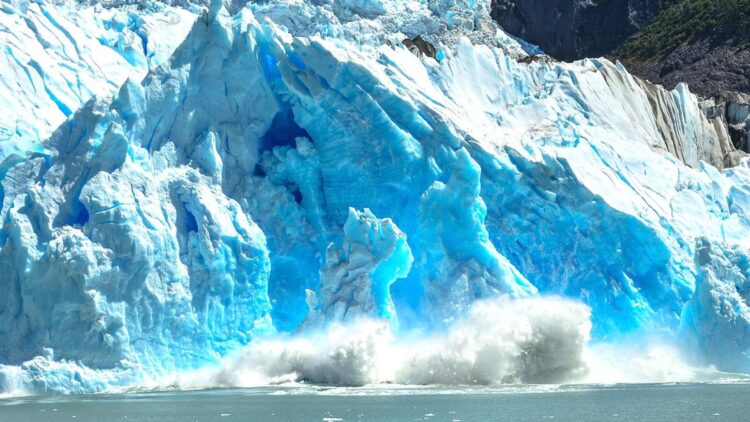
Antarctica has surprised scientists with an unusual event: the Hektoria glacier, located on the eastern Antarctic Peninsula, that suddenly collapsed and moved backward much faster than anyone had ever recorded in modern history. In just two months at the end of 2022, the glacial mass lost almost half of its length and moved about 8 km backward. Researchers say this kind of rapid retreat had mostly been seen only in computer models or when studying the end of the last Ice Age.
This study was led by scientists from the University of Colorado Boulder and published in Nature Geoscience. Even though the Hektoria glacial mass is relatively small and by itself won’t rise significantly the sea level, experts believe it represents an important alert sign. So, let’s find out more about what’s happening in Antarctica, shall we?
Hektoria glacial mass
Grounded glaciers, which are the ones that sit on the seabed, normally move backward very slowly—usually just a few hundred meters per year. However, the Hektoria glacier behaved differently because, during late 2022, it retreated at a peak rate of about 0.8 kilometers per day, which is nearly ten times faster than any previously recorded grounded glacier retreat.
Scientists detected the change almost by chance while they were checking routine satellite images. They saw that the glacier was thinning, speeding up, and breaking apart. Large pieces of ice broke off in repeated events called calving, where chunks of ice separate from the glacial mass and fall into the ocean.
Between January 2022 and March 2023, the glacier’s front moved back around 25 kilometers, with the fastest and most dramatic change happening in just two months. During this period, nearby seismic stations detected signals similar to small earthquakes, which scientists think were caused by huge icebergs separating from the glacier. This is very relevant because the grounded ice contributes directly to the rise of the sea level when it enters the ocean.
Why the it collapsed so fast
The key to this collapse was below the ice. The Hektoria glacial mass sat on a flat and soft area called ice plain, located under the sea level nearby the point where the glacier goes from sitting on the seabed to floating.
The warm ocean water caused the glacier to thin, which led to the ice to float and separate from the seabed. So, the water entered some cracks and pushed under the glacier’s front, provoking large blocks of ice to break away quickly. Scientists compared this process to a line of domino pieces falling backward, when a section breaks, the next one becomes more exposed and vulnerable.
Another important factor was the disappearance of fast ice, a type of marine ice that remains attached to the coast and acts like a natural brace for glaciers. From 2011, fast ice in the bay had helped stabilize Hektoria and nearby glaciers. But in 2022, storms and warm ocean water broke up this protective ice, allowing waves to hit the glacier directly and speed up its collapse.
Climate change and Antarctica Peninsula
The Antarctica Peninsula is one of the regions which is warming the fastest on the entire planet. Temperatures have increased more than three Celsius degrees since the decade of 1950, several times faster than the worldwide average. The warmer air and ocean have lowered the amount of marine ice in the last few years.
When marine and fast ice disappear, waves travel further and hit directly the glaciers’ front which were previously protected. In Hektoria’s case, scientists believe the combination of warm water and the ice loss likely weakened it before its rapid retreat.
Climate models have been warning about this process: warmer ocean weakens glaciers from below before visual and sudden changes happen.
Why does a ‘’small’ glacier matter?
Scientists are concerned about its behavior because it suggests for larger glaciers that rest on similar ice plains.
The entire Antarctic ice sheet contains enough frozen water to raise global sea levels by around 60 meters if it were to melt completely. So, even a small fraction melting faster than expected could have serious impacts, such as more frequent coastal flooding, saltwater entering farms and drinking water supplies, and higher costs for communities near the sea.
The study shows that grounded glaciers can retreat in sudden jumps rather than slow and steady movement, which means current predictions may not fully capture the risk of rapid changes if similar collapses happen in bigger glaciers. Researchers also stress that scientists still do not fully know where all the weak spots under Antarctica are. Therefore, mapping the bedrock beneath glaciers is now considered essential to understand where future collapses might occur.
So, this event highlights why understanding Antarctica and monitoring its glacial masses is so important. Not only is this important for researchers, but for all of us.