
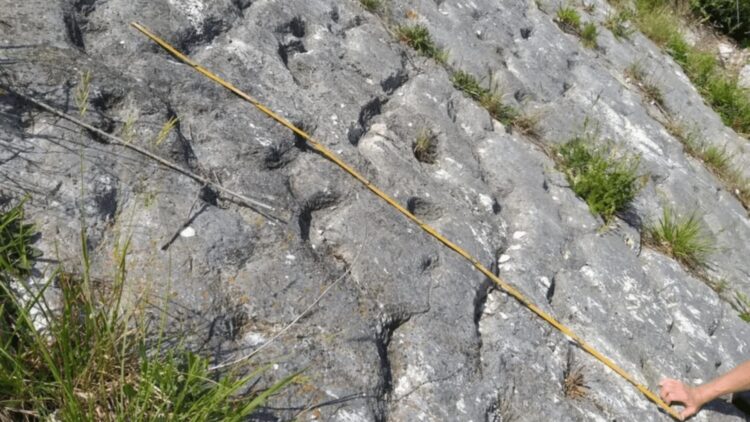
Today, we are going to talk about sea turtles. Well, actually, about a real story of how a group of Italian rock climbers found strange grooves in the rock that turned out to be evidence of a sea turtle stampede from nearly 80 million years ago. So, let’s find out more about these turtles and how the discovery was made.
An unexpected discovery
Everything started when a group of climbers were climbing the Monte Cònero, a mountain near the Adriatic Sea (Italy). They suddenly noticed long and repeated marks on the rocks, they weren’t like normal cracks or erosion signs. Once they looked closer, they saw the marks were the same as the ones they saw on the news, ones that belong to ancient marine reptiles.
As you can imagine, the climbers thought they discovered something important and they decided to contact Paolo Sandroni, a friend who is a climber and a geologist.
Scientific investigation
Paolo Sandroni called Alessandro Montanari, director of the Coldigioco Geological Observatory (OGC), and along with other researchers they decided to study the marks in more detail. So, scientists went back to the place where the climbers saw the marks, collected some rock samples, and used drones to record the area from above. The result? They found hundreds of grooves on a layer of limestone called Scaglia Rossa, a formation that has preserved millions of years of deep-sea sediments.
According to Montanari, although these rocks are now in a mountain, they were in the seabed in the past, hundreds of meters deep. However, with the passage of millions of years, Earth movements pushed the seabed upward, which is the mountain we see today.
What this shows about ancient turtles
After analyzing the rocks, researchers concluded that the marks were from about 79 million years ago, from the Late Cretaceous Period. At that time, the only animals that were big enough to leave these marks were marine reptiles like sea turtles (though plesiosaurs and mosasaurs could also have left marks).
Earthquake
Normally, the marks on the seabed don’t last very long because marine currents and small animals living there disturb the sediment. And then? Why were these marks preserved? Well, the answer is a submarine earthquake.
Scientists discovered that a submarine earthquake triggered an underwater avalanche of mud just minutes after the turtles made their tracks, which covered the marks immediately, preserving them for millions of years. Scientists think the earthquake scared the turtles, forcing many of them to flee at the same time. Some swam toward open water, while others moved along the deeper seafloor, creating a unique “stampede” pattern in the rock.
Opinions and doubts from other experts
Not every scientist completely agrees with the idea that the marks belong to marine turtles. For example, Michael Benton, professor of vertebrate paleontology at the University of Bristol, praised the study for its geological context but questioned the exact animal.
He notes that modern turtles swim efficiently, moving their front flippers in a figure-eight pattern rather than putting both down at once. Still, he agrees that the earthquake and underwater avalanche are clearly documented and likely caused the stampede behavior.
So…
Can you imagine having a nice day with your friends and finding out something from millions of years ago? That must have been so exciting for the climbers. But, most importantly, they found something significant for science and understanding a bit more about the past. Who knows if the next scientific discovery is found by you? Maybe next time you go for a walk you might find something important that could be studied in future studies.