
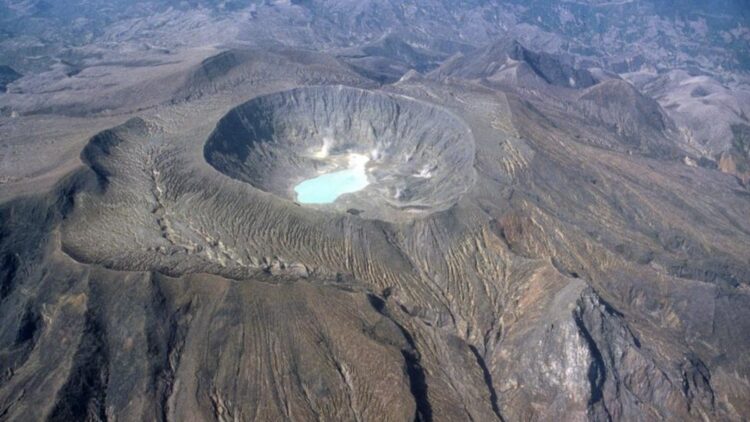
Volcanoes don’t always show their activity through huge explosions or lava rivers. In many cases, the changes are quiet and only experts can detect them. This is what’s currently happening in the Chichón volcano, located in the north of the Chiapas state (Mexico).
Researchers from the National Autonomous University of Mexico (UNAM) have warned about recent changes in the lake inside the volcano’s crater. So, let’s find out more about this active volcano.
Chichón volcano
This volcano is known for the strong eruption in 1982, a phenomenon that caused serious human and material losses, damaged the local economy, and forced many people to leave their homes. The total damage exceeded $117 million, and the eruption even had effects beyond Mexico.
After this eruption, a lake was created inside the volcano’s crater, which is about one km diameter and 200 meters deep. This lake is not a common feature of volcanoes, since it’s directly related to their inner activity.
Since it formed, the lake has contained sulfur-rich water and has reached temperatures close to 100 degrees Celsius, which is almost boiling.
Recent changes
According to Patricia Jácome Paz, a researcher from the Department of Natural Resources at the Institute of Geophysics (IGf) of UNAM, the lake has recently shown physical and chemical changes. These changes were identified through samples collected over more than 20 years.
Scientists have detected variations in the substances dissolved in the water and changes in how water and gases move within the volcano’s hydrothermal system. In simple terms, this means that the hot water and gases inside the crater are behaving differently than before.
One of the most noticeable changes is the color of the lake. Before, the color was mainly influenced by algae, and now there has been a stronger presence of sulfates and silica, which are materials that indicate ongoing volcanic activity within the lake.
Sulfates and high temperatures
Another important finding is the presence of hollow sulfur spheres floating on the surface of the lake. These spheres form when gas bubbles rise from the bottom of the lake through liquid sulfur.
The spheres float for a short time before breaking apart, which shows that there is a pool of liquid sulfur at the bottom of the lake where temperatures have reached as high as 118 degrees Celsius. This temperature is even higher than boiling water.
Gas emissions
Between June and August 2025, an increase in seismic activity was recorded at El Chichón volcano. This caught the attention of many specialists from several institutions, who traveled to the area to evaluate the situation.
According to Dr. Patricia Jácome Paz, the current activity is hydrothermal, meaning it is related to hot water and gases, and it can only happen in the crater. Also, there is a possibility of small steam-driven explosions, known as minor phreatic events.
What’s more, it’s important to mention that there is no evidence of fresh magma rising toward the surface. Because of this, scientists believe that the chance of an eruption similar to the one in 1982 is very low.
So…
El Chichón reminds us that nature is powerful and sometimes unpredictable. Even without lava or explosions, changes in a volcano’s lake can tell a story about what’s happening underground.
Watching, learning, and following safety guidelines are the best ways for all of us to stay informed and prepared while appreciating the incredible forces of our planet.