
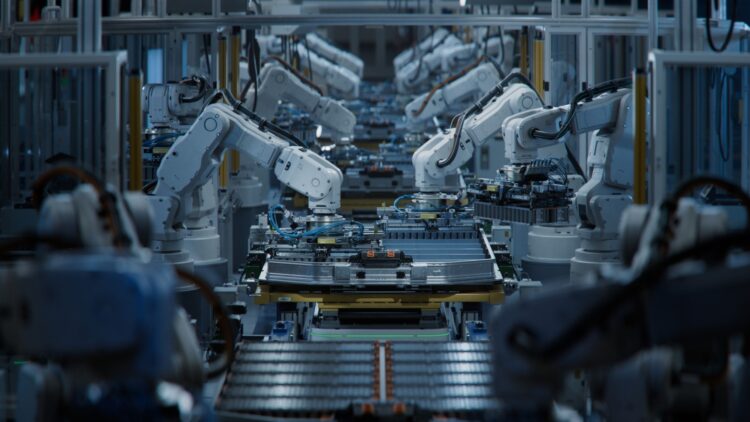
In the last few years, technology has advanced so much and Xiaomi is a great example of this. It is one of the biggest technology companies in China and it has introduced a very special plant that almost operates with no people.
This has caught many people’s attention around the world because it makes us wonder if we are reaching the point where machines are doing almost all human jobs. So, let’s find out more about what Xiaomi is doing and China’s technological situation.
Producing a phone per second
Xiaomi has started a totally automated plant in China, which means that most of the work is not done by humans, but machines and robots monitored by computers. The plant is huge, about 870,000 square feet, and its production capacity is very high.
This plant is able to produce a phone per second and operates 24 hours a day without stopping. What’s more, it doesn’t need lights because machines can even work in complete darkness, which is why it’s sometimes described as a ‘’light-out factory.’’
Thanks to this way of production, Xiaomi can manufacture millions of phones in a short amount of time, something impossible with traditional methods.
Artificial Intelligence
The way this plant works mostly depends on an artificial intelligence system called HyperIMP, which is basically like the ‘’brain’’ of the entire plant. The HyperIMP is in charge of:
- Watching the machines in real time.
- Predicting possible problems before they happen.
- Automatically fixing issues when something goes wrong.
This means the factory does not need people constantly checking every machine. The AI system acts like a manager that never sleeps. Because of this technology, Xiaomi can produce up to 10 million high-end smartphones per year in this single factory.
Xiaomi and automatization
This project is not just a Xiaomi’s idea, it is also part of an important change in the way China produces its products. For many years, China was known for low-cost human labor, but that’s changing.
Today, China owns about half of all the industrial robots in the world, which makes it a global leader in advanced manufacturing. Xiaomi’s automated factory is a clear example of this shift.
This approach is closely linked to the national strategy known as Made in China 2025. This plan was created to strengthen key industries through innovation and technology. While not all of its original goals were achieved, China successfully reduced its dependence on the United States for critical technologies.
No human workers factory
Chinese officials and Xiaomi executives emphasize that the purpose of this factory is not only to produce more smartphones. The main goal is to free people from repetitive and physically demanding jobs. So, instead of working on assembly lines, humans can focus on:
- Research and development.
- Product design.
- Advanced maintenance.
In this model, people still play an important role, but their work changes. Basically, machines handle routine tasks, while humans focus on more complex and creative responsibilities.
Concerns and risks
Even though Xiaomi’s plant represents a huge advance, there are some concerns about it:
- High dependency on artificial intelligence. If the system fails, the production could be affected.
- Cybersecurity. Depending so much on digital systems, means the plant can be vulnerable to cyberattacks.
So…
Xiaomi stands as a great example of China’s transformation, and whether we feel this future is exciting or worrying, it is already happening and it is reshaping global manufacturing in ways that will affect everyone, including you.
What do you think about this new way of producing products? Will it be a positive change for the future that should be spread to more places?