
NASA has found something that will help understand how the cosmos was when everything barely started. Imagine someone screams in a far away place and that sound lasts billions of years until you hear it, that’s something similar to this NASA discovery. So, let’s learn more about this incredible discovery.
What NASA found
In the Goddard Space Flight Center and Jet Propulsion Laboratory (JPL), scientists were doing routine reviews and they noticed something unusual: a small but clear spike in radio data. The most striking thing about this was that it lasted about 10 seconds and was structured, not random.
At first, scientists assumed it must be an error. They tested for satellite interference, equipment problems, and signals coming from Earth, but none of those explanations fit. When other observatories confirmed they had detected the same signal from the same area of the sky, the finding became much more serious.
Such an ancient signal
The reason why NASA scientists know this signal is about 13 billion years is because the universe is constantly expanding. When an ancient signal travels for such a long time, it stretches and slows down (something scientists call ‘’redshift’’).
So, by measuring how much the signal had stretched, NASA could calculate when it started. The result indicated that it was released when the universe was very young, when the first stars and galaxies started forming. At that monet, the cosmos was a chaotic place, full of energy and extreme phenomena, which is why this brief signal’s origins had to be something very powerful.
Where does the signal come from?
According to NASA scientists, the signal was probably caused by a violent event in the primitive universe. Among the possible explanations, we find:
- The formation or collision of early black holes.
- A massive star collapsing.
- A powerful burst of energy from a young galaxy.
Each of these events releases enormous energy, enough to send detectable signals across billions of years of space and time.
How NASA listens to the universe
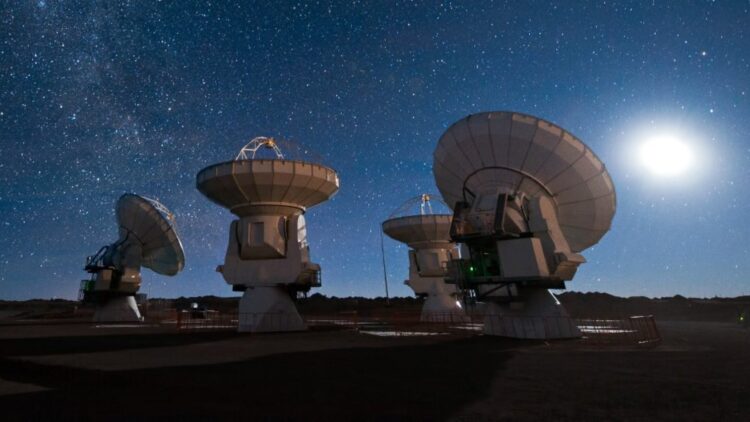
Detecting a signal like this is a matter of luck. NASA and other scientific institutions plan long observation campaigns, sometimes staring at the same dark patch of sky for weeks. Space telescopes like the James Webb Space Telescope work alongside ground-based observatories such as ALMA and the Very Large Array.
Raw data from these instruments is messy and full of interference, but advanced software removes noise step by step, leaving behind only the most reliable signals. Thanks to this process this faint 10-second burst was finally noticed.
Scientists then compare models to determine what kind of cosmic event could match the signal’s shape, strength, and duration.
Importance of this signal for us
Understanding how the universe was at the beginning of its existence helps us improve scientific models that explain its expansion. Those same models are used later in technologies that are part of our daily life, like satellite communication and GPS systems.
What’s more, this discovery reminds us that the universe keeps ancient stories we are still trying to listen to because they are the pieces of the puzzle of our origin.
So…
You don’t need to be a scientist to appreciate what this means. It shows that even the smallest signal can carry a huge story, and that curiosity—like NASA’s—allows us to uncover it.
The universe is vast, ancient, and full of unanswered questions, and this discovery gently invites you to wonder, to look up, and to remember that our place in the cosmos is part of a much bigger story still unfolding.
Can you imagine if a teenager hears about this NASA finding and finds out they want to become a scientist one day? That would mean one more person wanting to understand the unknown and giving us answers about the universe.