
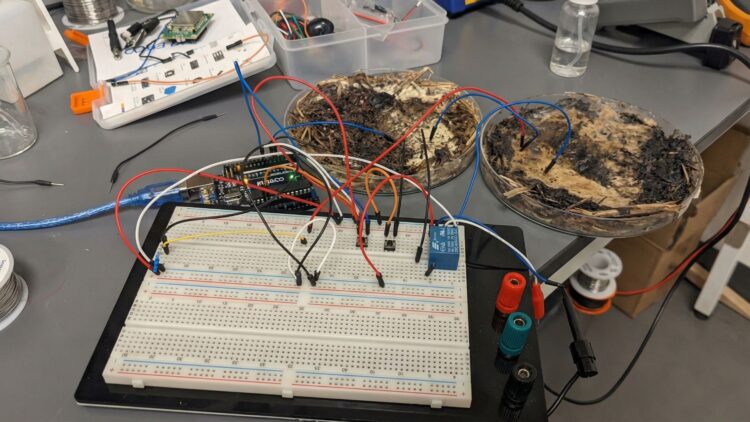
When people think about shiitake mushrooms, they imagine them as part of their ramen bowl or as complement for some other hot pot recipe. Few people—even the nerdiest of your friends—will ever find any relation with microchips. However, they are being used as biological processors that can save, process and retrieve information like any standard chip—only without the outrageous current prices!
Researchers at Ohio State University have proven that fungi can be taught to behave like memristors, the tiny elements in computer chips that manage and hold data. The group discovered that hardware built from shiitakes showed consistent memory abilities comparable to silicon chips, suggesting they could serve as the foundation for other cheap, green components that mimic the brain.
John LaRocco, the lead researcher from Ohio State’s College of Medicine, explained that building microchips which copy real brain activity removes the need for high power consumption during standby or idle times. He added that this efficiency represents a massive opportunity for saving money and improving computational performance.
How can mushrooms even retain memories?
A memristor, or memory resistor, is a component that shifts its resistance based on the history of current flowing through it, effectively recalling previous electrical signals. While standard memristors rely on silicon or metal oxides and need rare minerals, high heat to build, and lots of energy to work, fungal mycelium is different. This underground web of threads, which helps mushrooms eat and share signals, grows at room temperature and is completely biodegradable when it wears out.
LaRocco pointed out that while mycelium has been studied as a base for computing in more confusing arrangements before, their project attempts to test the absolute boundaries of these memory-capable systems.
Cultivating the (biological) hardware
The team grew shiitake and button mushrooms on natural nutrients in lab dishes until a thick layer of mycelium spread across the surface. They then dried these mats out and wired them into electronic systems. Once they ran voltage through them at frequencies between 10 Hz and 5,850 Hz, the mushroom setups started functioning as organic memristors.
LaRocco explained that they hooked up wires and sensors to various locations on the mushrooms because different sections possess unique electrical qualities. He noted that the performance varied based on the voltage levels and how the connections were made.
Rivaling RAM speeds
Over the course of two months, the group found that the fungal device could act like RAM, toggling between states and retaining data at speeds reaching 5,850 signals per second with about 90% precision. When the speed was lower, the switching accuracy hit 95%. Although efficiency decreased as the voltage frequency rose, they realized this could be solved by wiring more fungi into the loop.
Although using mushrooms in electronics isn’t a completely fresh idea, there is a growing fascination with utilizing fungi for energy and computing tasks. The mycelium builds a 3D network that heals itself and sends out electrical pulses when stimulated, much like neurons in the brain do. Unlike silicon, this organic framework is pliable, easy to expand, and can grow into new shapes. On top of that, it is far kinder to the planet than modern synthetic alternatives.
Qudsia Tahmina, a co-author and associate professor of electrical and computer engineering at Ohio State, noted that people are getting much more conscious about protecting the environment to keep it safe for the future. She suggested that this awareness is likely a major reason why eco-friendly concepts like this are gaining traction.
Fungal computing and what it entails for nanorobotics
Although these organic memory devices are still in the beginning stages, the team intends to figure out how to cultivate the fungi so they shrink down to a practical size for everyday use. Scientists are also currently experimenting with fungi to build batteries and generate power.
LaRocco remarked that everything required to investigate fungal computing ranges from a simple compost pile and DIY gadgets to a massive production facility using standard molds. He emphasized that all these approaches are possible right now with the tools we already have.
The study appeared in the journal PLOS One.