
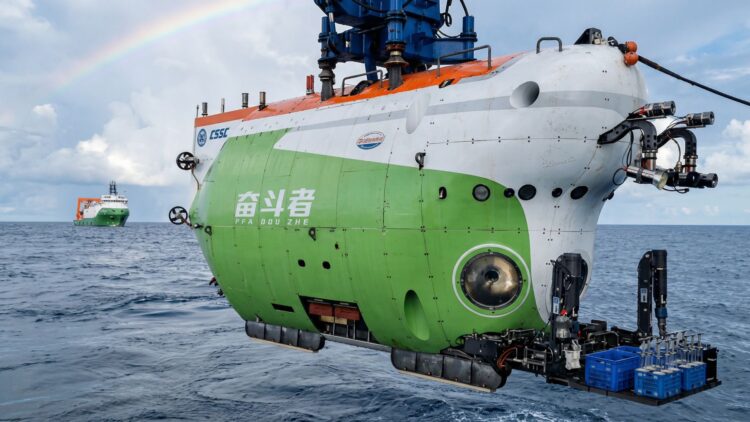
The Ministry of Natural Resources reported that China successfully finished 43 piloted dives during its 2025 trip to the Arctic, which included joint operations involving two deep-sea vessels carrying crews.
Elizabeth Buchanan, an expert on polar politics at the Australian Strategic Policy Institute, points out that this is really about developing deep-ocean resources for the long term. She believes China is setting itself up to become the global frontrunner in managing the seabed and its assets.
Exploring one of the last pristine seabeds
Lying deep under the ice between Greenland and Siberia, the Gakkel Ridge is a submerged chain of volcanic peaks. It belongs to the worldwide system of mid-ocean ridges where tectonic plates separate and generate fresh crust, a process that usually happens without anyone noticing.
In the past, experts only knew this ridge from sonar charts and a handful of brief trips using robotic subs. While a 2003 study in Nature found hot vents on the western end, the eastern side was unreachable until now, which is why Huang referred to it as the final part of the puzzle.
A fleet uilt to withstand extreme conditions
The underwater missions relied on two submersibles, named Fendouzhe and Jiaolong, which were transported by the research ships Tan Suo San Hao and Shen Hai Yi Hao. Altogether, China sent a fleet of five scientific vessels, one of which was an icebreaker, to the region last summer. Each of the vehicles is designed to go down at least 7,000 meters, and the Fendouzhe famously made it to 10,909 meters at Challenger Depth back in 2020.
The team spent nearly a hundred days at sea gathering rocks, water, biological specimens, and core samples of sediment from the ridge. They also used sonar and cameras to chart the underwater hills and canyons, swapping out the fuzzy shapes on old maps for clear visuals of the bottom.
A primary objective is to find out if the eastern Gakkel Ridge hosts hydrothermal vents, which are deep-sea hot springs that support creatures running on chemical energy rather than sun power. Since studies in Nature from 2003 and Nature Communications in 2022 confirmed such life exists on the western part of the ridge, these fresh samples might reveal similar harsh ecosystems and help shape theories about life in the dark oceans of icy moons like Europa.
What this kind of maneuvers entail in disputed waters
These operations took place within the Beaufort Sea as well as along the Gakkel Ridge in the middle of the Arctic Ocean. The Gakkel Ridge sits on the seabed where nations like Russia, Denmark, and Norway have conflicting claims over who controls the continental shelf.
This milestone confirms China’s rising status in polar studies, an arena historically ruled by Russia and the West.
A story on the state-run broadcaster CCTV focused on the technique where two manned subs work together underwater. Researchers mention that using two submersibles proved there are new capabilities in steering, communication, and safety under the ice that are vital for future Arctic missions.
Over the last ten years, China has consistently ramped up its presence in the Arctic by deploying icebreakers, science ships, and robotic subs. The government in Beijing describes this work as a plan for peaceful scientific growth, focusing on studying the climate, ocean life, and charting resources on the seafloor, all while trying to establish a presence along new northern shipping lanes.
Buchanan wrapped up by saying that the speed at which China is defining the strategic landscape in the Arctic is quite remarkable.
Just last month, a cargo ship from China set a record by traveling from Asia to Western Europe through the Arctic in only 20 days, becoming the first to make that specific connection. Looking ahead to next summer, the company behind the Istanbul Bridge intends to increase their schedule to include 16 trips.