
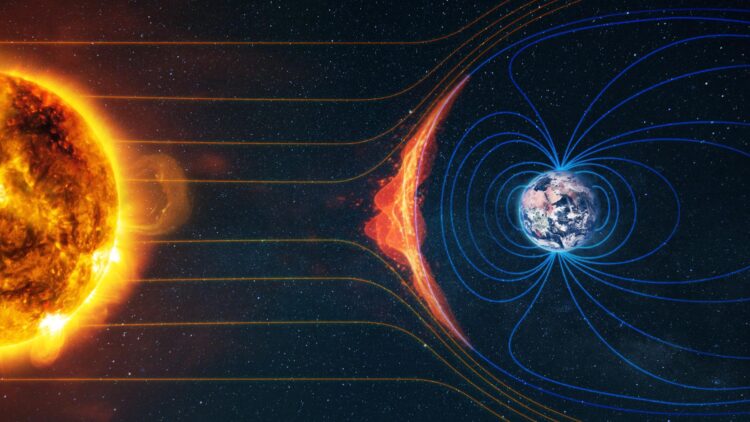
The magnetic north pole has been wandering through the Arctic for decades, but lately, its changing path has grabbed the interest of researchers and people who depend on accurate navigation. Since the turn of the century, the pole has picked up speed and headed for Siberia, prompting experts to ask what is causing this strange drift and why the movement is significant.
“So, is the North Pole somewhere else now?”
It is important to remember that the magnetic north pole isn’t the same thing as the geographic North Pole, which is the unmoving spot where the Earth’s axis hits the ground. Magnetic north, on the other hand, is a moving target that marks the spot where the planet’s magnetic field lines come together.
This invisible force is created by the swirling action inside the planet’s outer core, a sea of liquid iron and nickel starting about 1,800 miles down. As the flow of that liquid metal changes, the magnetic pole moves along with it, a process scientists call the geodynamo. Currently, though, something odd appears to be going on.
William Brown, who models the global geomagnetic field for the British Geological Survey, stated that they haven’t seen the magnetic north act like this in the past.
Has Earth’s magnetic pole shifted overnight?
Let’s not panic; ever since James Clark Ross first located it in 1831, the magnetic north pole has been drifting. Across the last century, its pace from Canada toward Russia picked up considerably, going from a crawl of about 6 miles per year to a sprint of 31 miles annually by the 2000s. That said, the speed has dropped off sharply in the last five years to roughly 22 miles per year, a change Brown described as the most dramatic slowdown they have ever recorded.
Researchers in the U.K. and the U.S. have been tracking this journey for a long time. Every five years, they put out an updated World Magnetic Model (WMM), which serves as the reference map for GPS units and other navigation gear.
The most recent update, published in December, confirms that the pole has moved even closer to Siberia since the last report.
What does this mean for modern nagivation technology?
This drift is a big deal for businesses like aviation and shipping that depend on magnetic fields to get around. To work correctly, everything from GPS units to jets and military gear needs precise maps that track where magnetic north actually is. Whenever the magnetic field changes, those maps have to be adjusted to match the new reality.
Arnaud Chulliat, a researcher with the University of Colorado, Boulder, and NOAA, explained to CNN that waiting too long to update the model just leads to bigger mistakes. He added that the way they design the model means their forecast is essentially a projection based on what they currently understand about the field.
Researchers still don’t know exactly why the magnetic north pole’s pace shifted so wildly. A few experts think that fluctuations in magnetic intensity around Canada and Siberia might be driving the change.
Still, nobody is quite sure what caused it to speed up and then slow back down. Brown explained to Skyler Ware at Live Science that the magnetic field acts in “complicated” and “chaotic” ways, making frequent updates to the WMM necessary.
Back in 2019, experts had to push out the WMM a year ahead of schedule since the pole was drifting way faster than normal. Even if these shifts look small to most of us, they really matter for any system that uses magnetic fields to find its way. The newest WMM features a far more detailed map of magnetic north to help navigation tools stay accurate.