
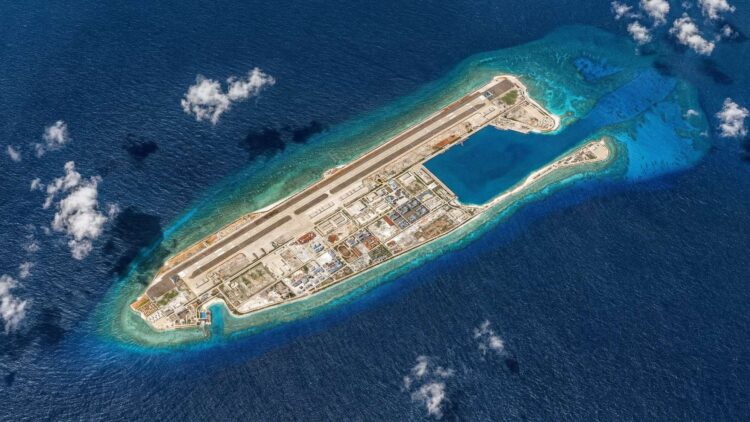
According to a research group in the U.S., nations competing for the South China Sea have wiped out nearly 28.3 square kilometers of coral reefs while building artificial islands to support their territorial claims, with China causing the most harm followed by Vietnam.
A titanic construction with gargantuan impact on fauna
The Asia Maritime Transparency Initiative, or AMTI, used satellite photos to study the construction projects carried out by the different countries involved, including China, Vietnam, Malaysia, Taiwan, and the Philippines.
The organization, which is part of the Center for Strategic and International Studies in Washington, stated that digging up the sea floor and dumping landfill has permanently ruined the marine environment and fundamentally altered the shape and health of the reefs in the region for the long term.
The disastrous toll on the surrounding ecosystem
In its report, AMTI pointed out that China is the biggest driver of reef loss, having covered up about 4,648 acres of coral since 2013. The group noted that Vietnam ranks second, with roughly 2,362 acres destroyed, primarily during 2024.
The overall footprint of the destruction grew by 800 acres, rising from a total of 6,200 acres recorded at the end of 2023. According to AMTI, China accounts for 65% of this total loss, while Vietnam is behind 33% of it.
Back in a December 2023 update, the group noted that constructing islands isn’t the only problem; Chinese fishermen digging for giant clams have wrecked an additional 16,353 acres of coral.
AMTI reports that Manila is preparing to launch a second legal case against Beijing for environmental damage in the West Philippine Sea, a part of the South China Sea that falls within the Philippines’ exclusive economic zone where they control the water and seabed resources.
But the Marcos administration still hasn’t settled on which court should hear the case.
Meanwhile, AMTI noted that Malaysia, Taiwan, and the Philippines combined are responsible for less than 3% of the total destruction.
A decade long coral beef reef battle
Back in 2016, the Philippines won a legal victory against China using the UN’s Law of the Sea, but Beijing simply refused to accept the decision.
Greg Poling, who runs AMTI, thinks Manila should push the U.N. General Assembly to pass a resolution demanding that the 2016 ruling be followed, along with a request for the International Court of Justice to weigh in on if China’s actions are breaking global treaties.
According to Philippine legal expert Jay Batongbacal, the country will likely have to handle this on its own just like last time, since the rest of the ASEAN group has a policy of not getting involved in these kinds of disputes.
The expert told Radio Free Asia that China appears to have been pushing back against the Philippines’ complaints about environmental harm since last year.
Researcher Dinh Kim Phuc stated that Vietnam simply has to take these actions for strategic defense, even if it hurts the environment.
“You can’t just look at saving the ocean in isolation,” he explained to RFA. “It has to be balanced with the security of the whole region. As long as China insists on controlling the whole South China Sea, the environment will keep getting destroyed to serve other goals.”
During a special briefin regarding maritime law, China’s coast guard blamed other countries for ruining the South China Sea’s ecosystem and claimed that Beijing is actually doing a great job protecting it. According to Batongbacal, these public briefings might be intended as a way to strike first against Manila’s strategy.
Speaking to the Global Times, China Coast Guard spokesperson Liu Dejun claimed that law enforcement came down hard on illegal fishing, trash dumping, and poaching in 2024, detaining over 500 foreign ships and seizing 15 of them.
Liu mentioned they caught one foreign boat poaching coral—seizing over 1,200 live pieces and a pile of giant clam shells—but he didn’t say which country the ship was from.