
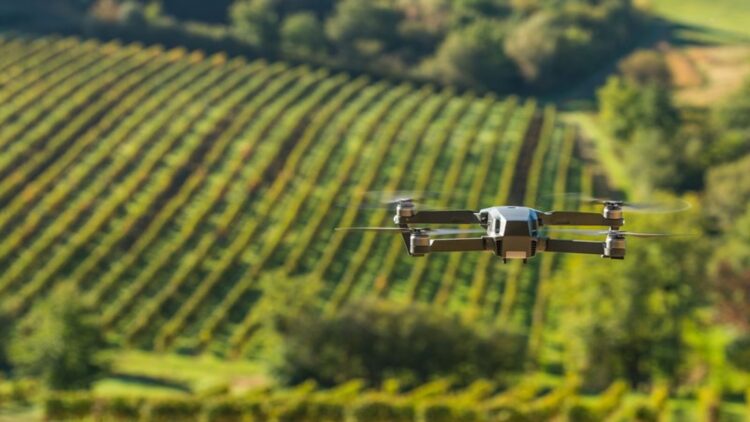
Artificial intelligence is where technological developments have reached their peak. And what we’ve realized is that AI and technology can be applied to virtually every sector that concerns humankind, including vineyards. In California vineyards, the incorporation of sensors, artificial intelligence, and supercomputers is driving a profound transformation in agricultural production, according to the University of California, San Diego. With drones and state-of-the-art computers, it’s possible to change the harvest from one year to the next.
A way to modernize the sector through sensors, computers, and artificial intelligence
In California, vineyards have joined this revolution, and various systems are already being implemented to optimize processes and resources in grape cultivation. Specifically, the project developed at Iron Horse Vineyards, near Sebastopol in Sonoma County, is part of this “new” world. Through sensors, computers, and artificial intelligence, a way to modernize the sector and pave the way for new methods of operation is taking shape. Precision agriculture, as it is known, is expanding in different regions of California thanks to collaboration between researchers, producers, and universities.
It may seem somewhat idealistic, considering that agriculture is one of the most undervalued sectors
Specifically, the goal is to achieve sustainable production that adapts to current and future challenges, as well as to the different farming practices within the sector. Iron Horse Vineyards serves as a model, demonstrating how combining tradition and technology can significantly boost production. This new model seeks to optimize input use, anticipate the effects of climate change, and improve efficiency through the integration of environmental sensors, high-speed networks, and advanced data analytics. In other words, it aims to increase productivity at a lower cost. This may seem somewhat idealistic, considering that agriculture is one of the most undervalued sectors in society.
The goal is to gather as much data as possible to achieve the best possible results
One of the drawbacks of agriculture is its reliance on human labor. While many farming models have adapted to changing times and technologies, ultimately, without farmers, crops won’t grow. Therefore, at Iron Horse Vineyards, under the direction of Joy Sterling, sensors have been installed to measure soil moisture, temperature, fog, rainfall, and carbon dioxide levels. In short, the goal is to gather as much data as possible to achieve the best possible results.
This is something that, to a lesser extent, was already being done in California. The Sacramento-based company Land IQ has developed tools that allow producers and agricultural organizations to make data-driven decisions. Clearly, the only way to reap tangible benefits is by being as precise as possible when analyzing the data. Land IQ has a team of about 50 specialists in agriculture and space science, and its main work consists of mapping crops and analyzing agricultural land use. This information allows producers to know exactly what crops are planted, their extent, and their age. In the case of AI and data from the University of California, San Diego, the infrastructure is complemented by a 10-gigabit-per-second digital network, provided by CENIC (Corporation for Education Network Initiatives in California), which guarantees real-time data transmission to specialists at the University of California, San Diego.
Therefore, it’s a complex network where technology plays a central role. Technology at this level has been implemented for years, even in irrigation systems. In this sense, the system itself can detect leaks, for example, and cut off the supply, alerting to the fault. We often talk about human error in the most complex systems; the aim here is to avoid that ‘error’ as much as possible and turn it into learning, data, and benefits. It remains to be seen how these new processes continue to develop and adapt to the country’s fields.