
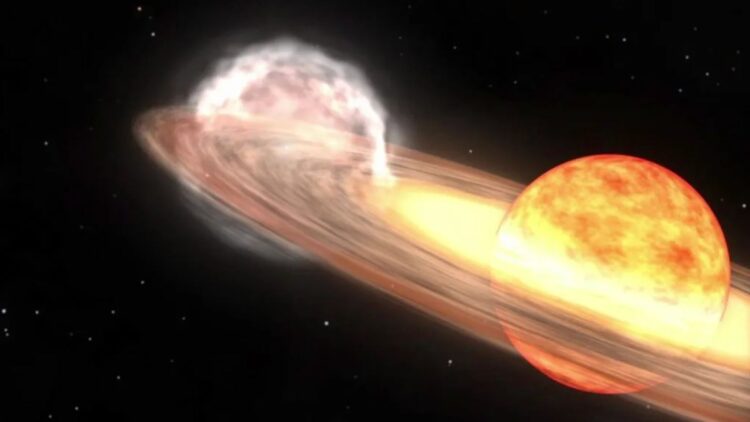
For about three years now, scientists have been anticipating a nova explosion. Specifically, the explosion of the binary star T Coronae Borealis is expected soon; a star that, according to scientists, is easily visible at dusk from the Northern Hemisphere. In this particular case, the outburst occurs approximately every 80 years, making this event all the more spectacular. As NASA explains, “T Coronae Borealis, the Northern Crown, also nicknamed the Northern Crown and known to astronomers simply as T CrB, is a binary system located in the constellation Corona Borealis about 3,000 light-years from Earth.”
This is a once-in-a-lifetime event that will train many new astronomers
With current information, scientists say the recurring nova could appear in the sky sooner than we thought. The T Coronae Borealis is part of a binary system where a small white nova and a red giant orbit each other, locked in a gravitational embrace. The accumulated hydrogen reaches extreme temperatures and pressures, triggering a thermonuclear explosion. “This is a once-in-a-lifetime event that will train many new astronomers, giving young people a cosmic event they can observe for themselves, ask their own questions, and collect their own data,” explained Dr. Rebekah Hounsell, assistant research scientist specializing in nova events at NASA’s Goddard Space Flight Center in Greenbelt, Maryland.
This triggers a thermonuclear explosion large enough to destroy the accumulated material
One way to explain how this phenomenon develops is that hydrogen from the red giant accumulates on the surface of the white dwarf, causing a buildup of pressure and heat. We already know that when such dispersed components mix, the reaction is usually especially intense. Therefore, over time, this triggers a thermonuclear explosion large enough to destroy the accumulated material. For T CrB, this event appears to occur, on average, every 80 years, as explained above.
A nova shouldn’t be confused with a supernova, which is a final, titanic explosion that destroys some dying stars
One thing that’s clear about this explosion is that it’s incredibly unpredictable. The first reports about the possible explosion date back to 2023; last year, scientists even set a date for the potential event. We’re still waiting for the explosion, but if it does erupt, it would reach a brightness similar to that of Polaris and would be visible for several nights. And by the way, as NASA clarifies, a nova shouldn’t be confused with a supernova, which is a final, titanic explosion that destroys some dying stars, Hounsell said.
“There are some recurring novae with very short cycles, but we generally don’t see one of these outbursts repeat within a human lifetime”
It’s interesting to understand certain terms that are frequently used within the scientific community close to astronomy. White dwarfs, for example, are the remnant cores of stars that have exhausted their nuclear fuel and expelled their outer layers. This is the final fate of most stars, including the Sun, which will reach this state in about 5 billion years. “There are some recurring novae with very short cycles, but we generally don’t see one of these outbursts repeat within a human lifetime, and one rarely occurs so relatively close to our own solar system,” Hounsell explained.
The fact is, the wait continues. The last T Coronae Borealis explosion occurred in 1946, and after the imminent explosion, the next one won’t happen until 2106. So, realistically speaking, this will be the only time that humans currently inhabiting Earth will be able to witness an explosion of this kind. Hence Hounsell’s reaction: “It’s incredibly exciting to have this front-row seat.” And of course, although a nova isn’t as energetic or luminous as a supernova, it’s still a remarkable astronomical spectacle and well worth witnessing.