
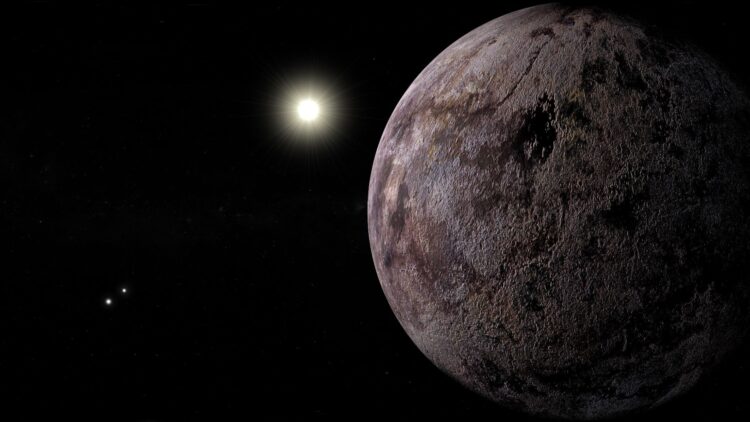
Data from the Kepler project has confirmed a new world that fulfills the telescope’s goal of locating Earth-sized planets near other stars. This discovery, named Kepler-78b, marks the first time we have found an exoplanet that matches Earth in both size and rocky makeup.
Earth’s (theoretical) twin
That is where the resemblance to our home ends, though. Kepler-78b races around its star in just 8.5 hours at a range of roughly 1.5 million kilometers, turning it into a scorching hellscape where life as we understand it cannot exist.
Andrew Howard from the University of Hawaii’s Institute for Astronomy noted that people have been discussing the “sungrazing” Comet ISON, which is expected to pass very near the Sun next month. He explained that because the comet will approach the Sun at roughly the same distance that Kepler-78b orbits its own sun, this planet essentially spends its whole existence skimming a star.
A planet that shouldn’t be there
Astronomer David Latham of the Harvard-Smithsonian Center for Astrophysics (CfA) commented during the webcast that this is a world that really shouldn’t exist, even though it does. Kepler-78b is roughly 20 percent wider than Earth, spanning 14,800 km (9,200 miles), and packs about 1.7 times the mass.
Because of this, astronomers believe its density matches ours, meaning it is likely built of rock and iron just like Earth. We have found other planets that are either the same size or weight as Earth, but Kepler-78b is the first one where we know both.
Having both numbers lets scientists work out the density to understand exactly what the planet is made of. The star it circles is a bit smaller and lighter than our Sun and sits about 400 light-years away in the constellation Cygnus.
But the tight orbit of Kepler-78b is a real puzzle for theorists. Based on how we think planets form, it shouldn’t have been born that close, and it shouldn’t have been able to move there either. At the time this system was coming together, the young star was much bigger than it is today.
That means Kepler-78b’s current path would have been deep inside that puffed-up star. Team member Dimitar Sasselov from CfA explained that it couldn’t have grown right there because you can’t build a planet inside a star. He added that it couldn’t have started further out and drifted in, because it wouldn’t have stopped until it hit the star, making this world a total mystery.
Howard offered one theory that the planet is the leftover core of an old gas giant, but even that explanation has holes in it. Howard admitted that they simply have no clue where this planet came from. Still, both teams of astronomers believe finding it is a good sign for the hunt for habitable worlds down the road.
Both distinct research groups relied on telescopes located here on Earth to verify Kepler-78b and learn more about its specific traits. Howard’s group worked with the W. M. Keck Observatory, situated high up on Mauna Kea in Hawaii. Meanwhile, Francesco Pepe from the University of Geneva guided the second team, conducting their observations from the Roque de los Muchachos Observatory on the island of La Palma in the Canaries.
To figure out how heavy the planet is, the researchers used the radial velocity technique, which tracks the slight wobble in a star caused by the planet’s gravitational pull. In contrast, the Kepler telescope calculates the planet’s width based on how much light disappears when the world crosses the face of its star.
Just like a three-day-old jug of milk, it has an expiration date
As for Kepler-78b, it is a planet with no future—at least for potential colonization for humankind. Gravitational forces keep dragging Kepler-78b tighter in toward its star. In the end, it will get close enough for the star’s gravity to tear the world to pieces. Experts expect the planet to disappear within three billion years. It is interesting that astronomers think our own solar system might have once hosted a planet like Kepler-78b. If it did, that world would have been obliterated ages ago, leaving no trace for us to find now.