
Airplanes are the means of transport that connects cultures, languages, customs, religions, and societies across the globe. If we stop to think about it, planet Earth is very small compared to the rest of the universe, but within this planet, getting from one end to the other is a real challenge. That’s why airplanes help us connect and communicate. In this sense, one of the greatest attractions of this mode of transport is the windows. Passengers can see the planet from angles that would otherwise be impossible. Now, the world’s first windowless passenger plane could be flying in two years, reducing the cost of private jet travel.
Aircraft can consume up to 60% less fuel than similarly sized planes, according to manufacturers
It’s all about cost savings. By eliminating the weight of the windows and designing a more aerodynamic fuselage, aircraft can consume up to 60% less fuel than similarly sized planes, according to manufacturers. Airbus, for its part, is currently facing two technical problems related to its A320 family of aircraft, as stated by its CEO, Guillaume Faury, in an interview with the German newspaper Bild. This could force manufacturers to opt for more extreme designs, abandoning the traditional “tube with wings” concept.
This adjustment is due to the impact of problems identified in the A320’s fuselage panels
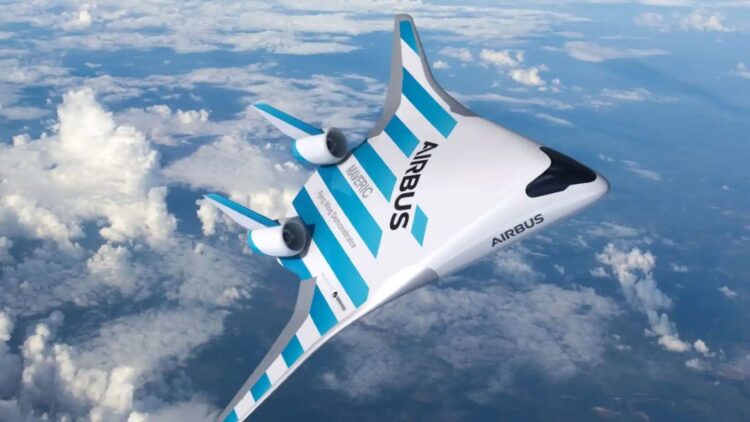
The fact is that the aviation giant reduced the number of aircraft it delivered in 2025; of the 820 planned, it delivered 790 last year. This adjustment is due to the impact of problems identified in the A320’s fuselage panels. Despite this change, it must be said that the company has maintained its financial forecasts for the full year unchanged. In this regard, Airbus also presented MAVERIC (Model Aircraft for Validation and Experimentation of Robust Innovative Controls) a few years ago. This is a small aircraft that Airbus engineers use and will use to experiment with new types of controls and configurations, which they can then implement in future models, according to experts.
This aircraft will feature a 1.8-meter-wide video screen connected to external cameras instead of windows
On the other hand, aircraft manufacturer Otto Aerospace unveiled the designs recently for its nine-seat Phantom 3500 business jet. This aircraft will feature a 1.8-meter-wide video screen connected to external cameras instead of windows. Specifically, Flexjet, a private jet company, has ordered 300 units; deliveries are scheduled to begin in 2030, following the first flight in 2027. Meanwhile, the CEO of Airbus also spoke about the competitive landscape of the aerospace sector, which is no longer defined solely by the long-standing rivalry with Boeing. Technology is advancing, and with it, competitiveness.
Some experts have stated that the Phantom 3500 could change the future of aircraft design
Regarding Otto Aerospace’s option, “As one of the largest commercial aircraft orders in the history of private aviation, this marks a turning point in the industry’s move toward sustainable and efficient air travel,” said Paul Touw, CEO of Otto Aerospace. While this initiative currently only includes private aircraft, the technology, if successful, could be applied to other types of aircraft. In fact, some experts have stated that the Phantom 3500 could change the future of aircraft design by demonstrating that thick glass and reinforced engineering around windows are not necessary.
In any case, whoever builds a windowless airplane first will reap the glory. Or not. While windowless aircraft have obviously been built, they’ve been used for other purposes, but until now, no passenger planes have been built without windows. For his part, Faury has made it clear that safety is a fundamental responsibility for the company, noting that around five million passengers fly on Airbus aircraft every day. In short, the day we see windowless commercial airplanes doesn’t seem far off.