
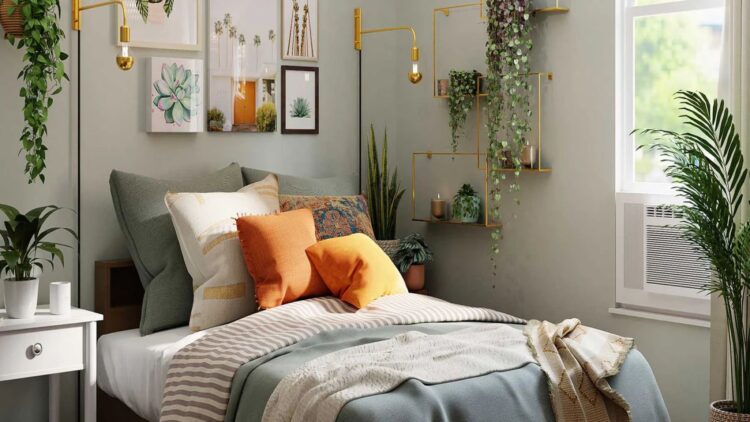
Like many things in human history, the use of plants in bedrooms to improve sleep and purify the air stems from a misunderstanding of a large-scale scientific project. And yes, we have to talk about NASA to understand this situation. In 1989, NASA tested the installation of various plants in sealed environments to see if the air quality improved and under what conditions. This was all done within the context of survival in places where opening a window was impossible. This led to the common misconception that NASA had demonstrated that having plants in the bedroom was healthy, but it turns out that this isn’t entirely true, and that wasn’t the objective of the research.
These factors had negative consequences for human health
The reality is that NASA never presented these results as a recipe for better sleep or as an alternative to ventilating a house. It all stems from the fact that in the late 1970s, when the energy crisis was being felt both at gas stations and in heating and cooling costs, buildings were being designed to maximize energy efficiency and help alleviate the soaring energy costs, as NASA explains. With new construction, a new approach to building homes was introduced, including ‘super insulation’ and reduced fresh air exchange. These factors had negative consequences for human health.
“After these buildings were occupied, workers began complaining of various health problems, such as itchy eyes, skin rashes, drowsiness, respiratory and sinus congestion, headaches, and other allergy-related symptoms,” NASA explains. Given this situation, a solution was urgently needed. Synthetic building materials, known for emitting or “off-gassing” various organic compounds, were linked to numerous health issues. All these factors collectively contribute to a phenomenon known as “sick building syndrome.”
This study began to be cited as if it were a practical guide for real bedrooms and living rooms
Faced with this situation, NASA began a study of air quality in these environments. Another promising approach to further reduce trace levels of air pollutants in future space habitats is the use of higher plants and their associated terrestrial microorganisms. “The leaves, roots, soil, and associated microorganisms of plants were evaluated as a possible means of reducing indoor air pollutants,” states the official research document. All this, of course, considering that in a real-world environment, ventilation and air exchange with the outside are far more effective than a few potted plants. The fact is, this study began to be cited as if it were a practical guide for real bedrooms and living rooms, when in reality it analyzed highly controlled laboratory conditions.
NASA study focused on a completely isolated environment, like a chamber or spaces designed for outer space
In short, plants can absorb small amounts of certain pollutants, add some humidity, and, above all, improve the feeling of comfort in a space. But they aren’t the key to cleaning the air; they help create a more pleasant environment. And it’s important to keep in mind that the NASA study focused on a completely isolated environment, like a chamber or spaces designed for outer space; the objective was never to improve the air in people’s homes.
“Given that human existence on Earth depends on a life support system involving an intricate relationship with plants and their associated microorganisms, it should be obvious that attempting to isolate oneself in hermetically sealed buildings, far from this ecological system, will lead to problems,” was the analysis that led to the conclusion of the NASA study. And indeed, this work resulted in the design of a novel approach that “uses plant systems to remove high concentrations of indoor air pollutants, such as cigarette smoke, organic solvents, and possibly radon,” states the study, which can be consulted here.