
When we think of the United Arab Emirates, most of us imagine hundreds of glass skyscrapers, supercars driving along immaculate highways, and immense oil wealth in the middle of the scorching desert. However, oil is no longer this nation’s most valuable asset, nor is it traded on the stock markets.
It is an invisible but essential resource for human life, which they keep buried. Under the sands of the Liwa desert, one of the driest regions on the planet, the UAE government has built an unprecedented feat of human engineering, in which they store a reserve of 26 billion liters of desalinated water. This is the largest strategic reserve of desalinated water ever created in the history of humanity.
The feat of the United Arab Emirates
The United Arab Emirates faces a very peculiar existential paradox: it is a nation immensely rich in energy, but extremely poor in the most basic resource necessary for human life. This region has no permanent rivers, natural lakes, or regular rainfall. To get water to a tap in a penthouse in Dubai or an office in Abu Dhabi, it takes a major engineering feat and the largest logistics network since the Roman aqueducts.
So much so that 90% of the nation’s drinking water comes from giant desalination plants located on the coast. There, these industrial complexes take water from the Persian Gulf, remove the salt at enormous energy cost, and then pump it to the cities. As you can see, the United Arab Emirates is completely dependent on this system, which creates a vulnerability for the safety of its population.
There are many factors: if a tide of toxic algae suddenly blocked the seawater intakes, the population would be left without water. If, unfortunately, there were a massive oil spill, a cyberattack on the power grid, or a regional armed conflict, the desalination system would be jeopardized, and with it the lives of the entire population of the country. At that time, the country only had water reserves for 48 hours, so it went from being classified as a simple municipal public service to a national defense asset. That’s when the new project to change this came in.
Aquifer myths
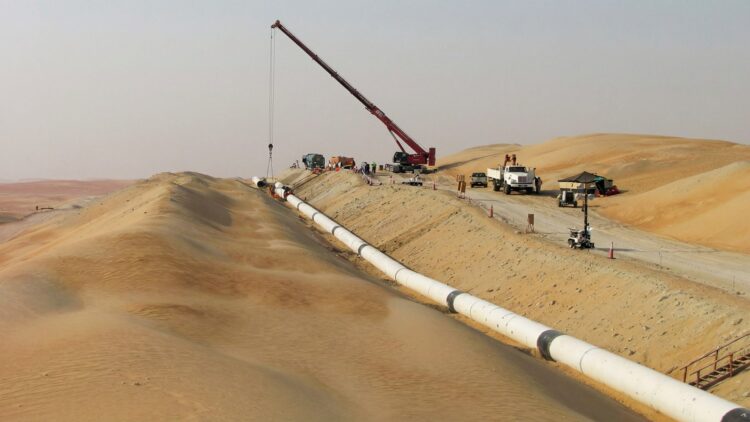
When we talk about underground freshwater reserves, we imagine caves or rivers, as if taken from the imagination of Jules Verne. However, the reality is a little less sophisticated. This project does not use caves, but rather the geological structure of the desert itself. This technique is called aquifer storage and recovery (ASR). To do this, they use an ancient natural aquifer beneath the desert. Here, the rock is porous, like a giant sponge. In order to fill this sponge, they had to build a pipeline across the desert and transport water from desalination plants on the coast to the interior—no less than 100 miles away.
The aquifer is so large that it took no less than 26 months to pump the surplus desalinated water steadily into the heart of the desert. Such was the engineering process that this water was injected into the pores of the underground rock at a depth of about 80 m. Underground, this valuable resource was safe from its greatest enemy, the scorching desert sun. With temperatures exceeding 113°F, millions of liters would have been lost to evaporation every day. Underground, however, the temperature is stable and water loss is almost zero percent.
Largest water tank on Earth
This engineering feat and years of work have finally paid off. Now, the United Arab Emirates has a reserve of 26 billion liters of desalinated water (6.868 billion gallons). The system is designed to recover and pump 100 million liters of drinking water per day to the city of Abu Dhabi. In total, they have created a reserve sufficient to maintain a 90-day supply for the country’s population. From just two days of reserves, the technocrats of the United Arab Emirates have managed to maintain the independence of their population for three months.