
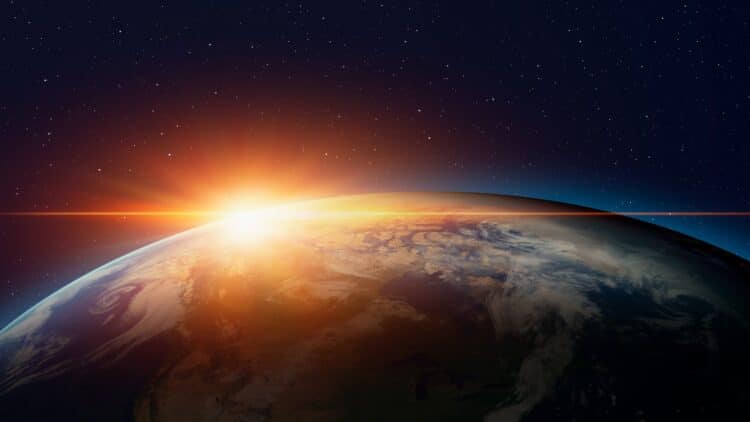
Right now, our world is teeming with life thanks to all the oxygen, but Earth wasn’t always like this. Researchers forecast that down the road, our air will turn back into a mix heavy on methane and light on oxygen.
We probably don’t need to worry about this for another billion years. That said, research from 2021 indicates that when the switch finally flips, it is going to be pretty quick. Basically, the planet is going to reset to the conditions seen before the Great Oxidation Event occurred about 2.4 billion years ago.
Oxygen has an expiration date on Earth
When the study came out, Kazumi Ozaki, an environmental scientist from Toho University, explained that the scientific community has debated the biosphere’s expiration date for a long time, looking at how the Sun gets brighter and how the carbon-rock cycle works.
This theory suggests that over vast stretches of time, carbon dioxide levels will keep dropping while the planet gets hotter. The team argues that breathable air likely doesn’t last forever on habitable planets, which complicates how we search for signs of life in deep space.
The team explained in their paper that the oxygen crash will likely hit hard—dropping to levels seen on ancient Earth—well before the planet enters a humid greenhouse state or loses all its surface water.
When that time comes, it’s game over for humans and almost every other living thing that needs oxygen to survive. We’d better hope we figure out space travel sometime in the next billion years.
What will happen when Earth runs out of oxygen?
The researchers figured this out by running complex simulations of Earth’s biosphere. They factored in the Sun getting brighter and the resulting drop in carbon dioxide caused by the rising heat. With less carbon dioxide available, plants and other organisms can’t photosynthesize as well, which eventually shuts down the oxygen supply.
Scientists used to think the Sun’s radiation would dry up the oceans in about 2 billion years. But this new model—which averaged nearly 400,000 scenarios—shows that the oxygen crash will actually wipe out life before the water is gone.
“The drop in oxygen is drastic,” Georgia Tech scientist Chris Reinhard told New Scientist. “We are looking at levels roughly a million times lower than what we have today.”
In search of other livable planets… which happen to have oxygen in their atmosphere
This research is especially important right now because it impacts how we hunt for habitable worlds beyond our own solar system. With stronger telescopes coming online, researchers need to know exactly what patterns to spot in the mountain of data these tools gather.
The researchers suggest that to find alien life, we might need to look for signals other than just oxygen. Their work was part of NASA’s NExSS project, which focuses on investigating habitability on other worlds. Based on Ozaki and Reinhard’s numbers, Earth’s oxygen-rich phase might only last for roughly 20 to 30 percent of the planet’s entire existence—and microbes will keep going long after we disappear.
Ozaki explained that the atmosphere after the oxygen crash will have tons of methane, low carbon dioxide, and no ozone layer. Basically, Earth will likely turn into a world ruled by creatures that don’t breathe oxygen. But that won’t happen in a long time, long after we are gone (whether extinct, or gone colonizing other planets), so let’s take a deep breath and enjoy our present oxygen right now!
If you would like to read more in detail about the subject, the whole study was published in Nature Geoscience, a paywalled scientific journal. This research was possible thanks to the collaboration of the the NASA Astrobiology Postdoctoral Program and also the Exobiology Program.