
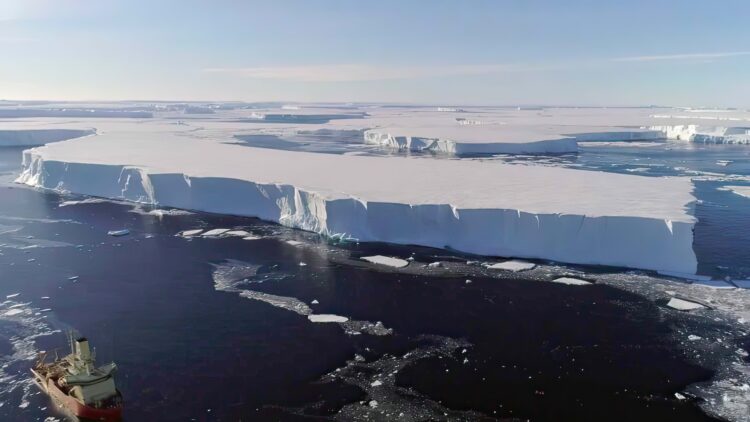
The Thwaites Glacier, located in West Antarctica and popularly nicknamed the “Doomsday Glacier,” holds enough ice to raise global sea levels by about 65 centimeters if it were to collapse completely. This increase would not only redraw coastlines on maps; it would manifest physically in flooded subway stations, more aggressive storm surges, and recurring floods in major coastal cities around the world.
Imagine how many apocalyptic movies could be made about that! Hollywood would make a fortune? They would make even more than they did during the 2012 end-of-the-world era… That is, as long as Netflix doesn’t beat them to it and make 200 mediocre series about how a cataclysm has flooded Planet Earth. (We—personally—are more fans of imagining an end of the world as we know it in the style of Plur1bus [available on Apple TV], where the planet remains the same, but it is the human race that has gone down the drain.)
But returning to the serious matter at hand, a new international study led by Debangshu Banerjee from the University of Manitoba’s Earth Observation Centre has revealed that a critical section of Thwaites is fracturing from within. As always, it is fracturing faster than initially predicted. There is no greater lesson in humility than seeing scientists rack their brains creating models to predict the future… and nature continuing to function in a completely opposite way that escapes our understanding.
But why is the glacier breaking away? Rather than basal melting (caused by ocean water from below) being the only factor of concern, the work shows that growing cracks in a fragile strip of ice are weakening the glacier’s grip on the seabed and accelerating its slide into the ocean.
Why scientists are losing sleep over the Thwaites
The Thwaites is the widest glacier on Earth and forms part of the West Antarctic ice sheet, a region that is already losing mass at an accelerated rate. Since much of this ice sits on a bedrock below sea level, it is particularly vulnerable to the intrusion of warm ocean water, which seeps in and thins it from its foundations.
Currently, floating ice shelves act as “brakes” for the glacier behind them, similar to a bottle cork. If these shelves weaken or break, more continental ice can flow freely into the ocean. This translates into sea level rise, which is already beginning to be reflected in higher insurance costs and increasingly expensive repair bills after coastal storms.
The International Thwaites Glacier Collaboration (ITGC), a joint effort between scientists in the United States and the United Kingdom, has warned that the continued retreat of Thwaites and adjacent glaciers could ultimately lead to a sea level rise of several meters over the next few centuries. Experts insist that this will not happen overnight, but they stress that decisions made in this century will determine how quickly this future unfolds.
Stalking a glacier for two decades
Banerjee and his team compiled twenty years of data for this new study, using high-resolution images from Landsat and Sentinel-1 satellites, along with detailed movement records obtained from GPS stations installed directly on the ice. They focused on the eastern Thwaites ice shelf, a floating expanse that is partially held in place by an underwater elevation known as a “pinning point.”
Between 2002 and 2022, the team tracked how cracks formed and spread in a narrow strip of ice called the shear zone, located just upstream of that underwater ridge. In simple terms, this is where blocks of the ice shelf slide past each other at different speeds, stretching and tearing the ice as if it were an elastic mass under too much tension.