
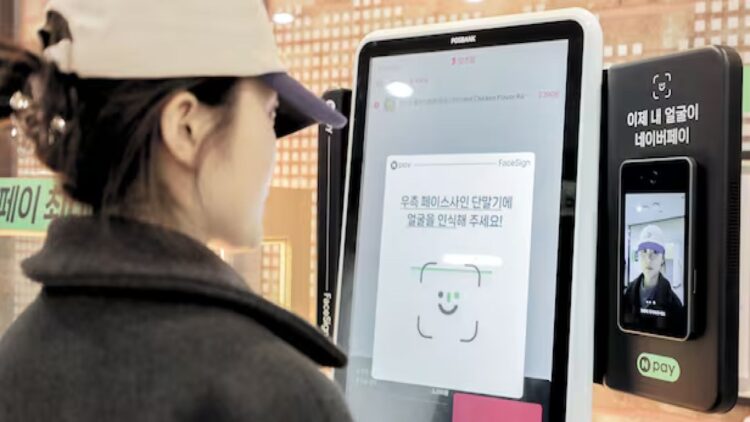
For many, it’s no longer unusual to be asked for facial recognition for certain things, such as going through airport security, unlocking a smartphone, or now, buying a phone line in South Korea. The South Korean government has announced that it will require local mobile phone companies to verify the identity of new customers through facial recognition scans, with the aim of reducing fraud.
Facial recognition will be mandatory for obtaining new mobile phone lines,
Until now, users have been able to choose whether or not to unlock their smartphones with facial recognition. But in South Korea, it will no longer be possible to purchase a phone line—a SIM card—without facial recognition. This method uses advanced technology, so facial recognition will be mandatory for obtaining new mobile phone lines, which will have direct implications for user privacy and rights. The country’s new policy expands existing customer authentication mechanisms, which require buyers to present verifiable identification documents at the point of sale, to include verification via facial scanning.
The country faces a problem with criminals who register mobile phone accounts and then use them to carry out scams
The measure aims to strengthen digital security, but it has raised concerns about its effects on user privacy and rights. As explained in a statement from South Korea’s Ministry of Science and ICT, the country faces a problem with criminals who register mobile phone accounts and then use them to carry out scams such as voice phishing. This has become widespread in many countries, and cases of fraud using this method are now commonplace.
The implementation of facial recognition is already reaching consumers. This verification will be used to confirm the applicant’s identity and thus prevent fraud, identity theft, and illicit activities linked to anonymous or fake accounts. South Korea’s three main mobile operators—SK Telecom, LG Uplus, and Korea Telecom—offer an application called “PASS” that stores digital credentials. This new system will use the facial biometric information stored in the application to verify identity. According to South Korean authorities, the measure is a response to an increase in cases of mobile line misuse, as explained above.
They expect the new verification requirement to make it much more difficult to register a mobile phone account using stolen data
This verification method is in addition to others already in place, implemented to prevent financial fraud and scams using numbers registered under false identities. South Korea, with a population of nearly 52 million, has suffered two major data breaches this year that affected more than half of its residents. The Ministry’s announcement regarding the plan states that it expects the new verification requirement to make it much more difficult to register a mobile phone account using only stolen data.
This new implementation has not been welcomed by the public, as not everyone agrees with this type of ‘attack’ on privacy. It’s a truly complex issue: is society trading security for privacy? Several digital rights and privacy advocates have expressed concern, pointing out that this type of biometric verification could open the door to increased state surveillance and the misuse of sensitive data if strict safeguards are not implemented. With this regulation, people will be traceable every time they buy a SIM card.
Therefore, on the one hand, we have the fact that Mobile Virtual Network Operators (MVNs) accounted for 92% of the counterfeit phones detected in South Korea during 2024; and on the other hand, we have the intrusion into the privacy of the country’s citizens. It remains to be seen how this news will be received by the public and whether it will eventually be implemented in other countries.