
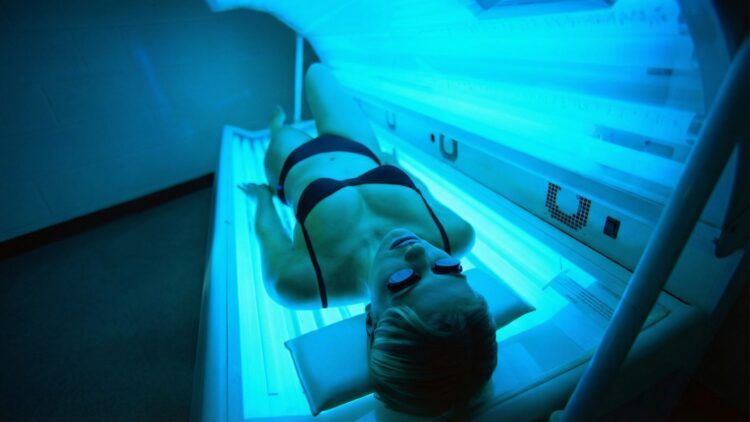
We only have a few days of vacation each year. So none of us wants to spend half of those summer days cooped up in a hotel room, afraid to go back to the beach and aggravate our sunburns. And let’s be honest: it’s very easy to get sunburned if we don’t use enough sunscreen. That’s why, in recent years, it has become very fashionable to have a UV session before going on vacation. To “acclimate” the skin before exposing it to hours and hours of sun on the beach. It seemed like the perfect solution. However, dermatologists have discovered that this “remedy” has no positive effects on your health.
Your skin loses its tan… but not the cellular damage
Undergoing ultraviolet light sessions is as harmful as exposing yourself to the sun without any sunscreen. To understand why this is so serious, researchers at Northwestern University and the University of California (UCSF) decided to look beyond superficial wrinkles. They analyzed the DNA of skin cells (melanocytes) from people who used tanning beds and compared them with those who had never used them.
The results surprised even the researchers themselves. Tanning bed users had an excessive amount of mutations in their DNA. To put it in perspective: the skin of young participants, aged 30 to 40, showed as much cellular damage as that of elderly people who had lived their entire lives in the sun.
The most disturbing thing is that this damage is silent. The study found that even in parts of the body where there were no visible moles or spots, the DNA was already broken. “We can’t reverse a mutation once it occurs,” warns Hunter Shain, one of the study’s authors. In other words, your tan will fade in a few weeks, but the “scars” in your genetic code will remain there for life, accumulating session after session and waiting for the moment to cause serious problems.
You’re paying to make yourself older
It was always believed that tanning beds were safer than direct exposure to sunlight because you can control the length of the session. But the reality is different. In these machines, ultraviolet radiation is almost as strong as that of the sun at midday at the equator. And that’s not the end of the problem. On a beach, you only receive radiation on one part of your body, the part facing the sun. In a tanning bed, your entire body is exposed to ultraviolet light.
This would explain why experts have discovered more cellular aging in young people who have used tanning beds than in older people who have only been exposed to sunlight.
The study showed that the most serious mutations were found in areas that are normally protected by clothing, such as the buttocks. These areas are protected from the sun on a beach, but not on a tanning bed. This would explain why the risk of developing melanoma is almost three times higher on a tanning bed than when exposed to the sun.
It should be remembered that melanoma is the most lethal type of skin cancer that exists. In fact, the World Health Organization classifies tanning beds as a high-risk device for cancer. Establishing their danger at a level as high as asbestos or tobacco.
Now, the problem is raising awareness among the population of the risks involved in wanting to achieve a quick and even tan. Social media and influencers make us want immediate results. However, health professionals strongly advise against the use of tanning beds. It is much better to use protective creams and gradually acclimatize your skin to the sun. And, if you want a quick solution, medical professionals consider self-tanning cream to be the least harmful option.
It is a simple and inexpensive way to get color without putting your health at risk. What good is looking great for the summer if your skin is going to age 50 years and you are going to develop a disease?