
Humanity is constantly discovering that things we thought were safe are actually very harmful to humans. For decades, arsenic was used to create a beautiful green dye, until it was realized that it was completely poisonous. During the Roman Empire, cookware and other cooking utensils were made of lead, even though they were slowly poisoning people.
Just 70 years ago, we were used to lead paint, which was very durable… But it emitted fumes. In general, things we thought were completely safe can turn out to be the opposite. This is precisely what a team of scientists from Pusan National University (PNU) in South Korea has discovered. This group of researchers has measured the levels of indoor air pollution emitted by everyday household appliances.
To do this, they used special laboratory cameras to measure emissions of ultrafine particles (or UFPs), which are carried through the air after being emitted by various appliances. These particles measure less than 100 micrometers in size… Not small enough to sink deep into our bodies.
Inconspicuous—but polluting—home appliances
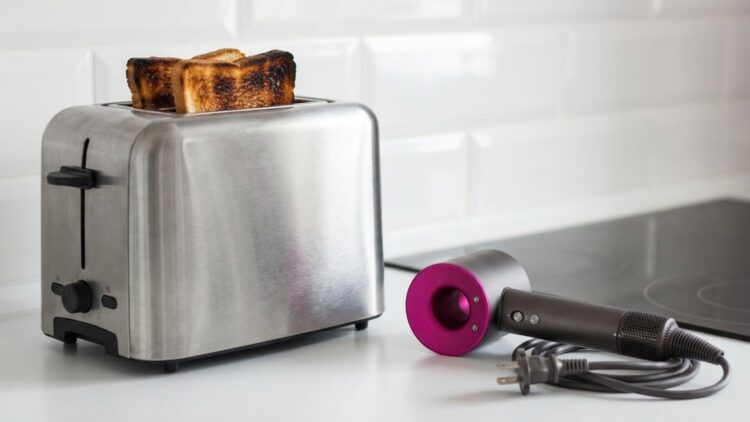
The research team tested different types of toasters, air fryers, and hair dryers. To their surprise, most of these appliances emit a large amount of ultrafine particles. The appliance with the highest incidence was, by far, a traditional toaster that pops the slice of bread up. This appliance alone emitted around 1.73 trillion PUFs per minute. If you were making toast right now, we’re sorry to ruin your breakfast. The emissions come directly from the heating wires, which release metal particles when they become red-hot.
The second major culprit was traditional hair dryers, the kind that use a brush motor. In fact, they emit between 10 and 100 times more particles than their modern brushless counterparts. This is because the mechanical friction of the carbon brushes in the motor generates a storm of nanoparticles.
The darling of the kitchen in recent years, the Air Fryer, was also a fairly high emitter. Like traditional toasters, it uses intensive heating coils that release metal particles when operating at high temperatures.
In fourth place are brushless hair dryers, which emit up to 100 fewer particles thanks to the absence of mechanical friction in the motor. However, the heating coils still generate a minimal amount of nanoparticles.
Its consequences on human health
Although this study did not directly address the possible effects on human health, the simulations showed that the ultrafine particles were too small to be filtered by the hairs in the nose, allowing them to penetrate deep into the lungs of children and adults. In fact, younger children could be more exposed to these particles because their airways are narrower. In addition, they breathe more air per unit of body weight than older students, so the deposition of these toxic particles in their lungs is much higher in proportion to that of an adult.
How to prevent poor air quality while using these appliances
Let’s be realistic, we’re not going to stop using the toaster, air fryer, and hair dryer, but we can adopt habits that optimize indoor air quality for the health of everyone in the household. The immediate recommendation is to ventilate the kitchen well when using the toaster or fryer. To do this, we can open the window wide and use the extractor hood.
If you already have a hair dryer that doesn’t work well, we recommend switching to a second-generation model with a brushless motor. You should also maintain good ventilation while drying your hair: leave the bathroom window and door open.
If you don’t have a window, turn on the bathroom exhaust fan before turning on the hair dryer, and leave it running for about 10 minutes even after you have finished drying your hair. This will help remove any particles in the air.